PERSON DIRECTORY
Emad Mostaque
Emad Mostaque appears in 25 indexed conversations across Moonshots, The Cognitive Revolution. This directory brings every appearance, source, TL;DR, digest, and transcript into one searchable feed.
OpenAI Agents Hijack a German Website, Jensen Declares AGI Arrived, and OpenAI Solves Navier-Stokes
Peter DiamandisSalim IsmailDave BlundinAlexander Wissner-GrossEmad Mostaque
Astra reportedly delivers 3.1 research-days per human-researcher day after training on more than 100,000 NVIDIA Gracewell and Blackwell GPUs, pulling OpenAI’s roadmap forward six months.With 10,000 agents tackling Navier–Stokes for approximately $6.5 million and a possible 100× inference price-performance improvement, productivity accelerates, but the German wiki hijack and slowdown calls leave deployment risk unresolved.
Sam Altman: Singularity Slow-Down, Emad Runs 18 Grokbots, Waymo Slashes Hardware 83% | EP #283
Peter DiamandisSalim IsmailDave BlundinAlexander Wissner-GrossEmad Mostaque
Sam Altman's retreat from step-function singularity claims highlights institutional inertia, model readiness, and competing narratives around AI timelines.Chinese open-weight models now approach frontier performance at dramatically lower cost, while agent swarms and Waymo's 83% hardware reduction point toward vertical integration and intensifying pressure on US labs, infrastructure, and regulation.

OpenAI Pauses Frontier Training, Elon's 100X Prediction Lands, Robot Beats Usain Bolt | EP#282
Peter DiamandisSalim IsmailDave BlundinAlexander Wissner-GrossEmad Mostaque
OpenAI’s RL pause drew safety-versus-marketing disagreement, while recursive self-improvement may command more revenue per token than enterprise codegen, keeping frontier models internal.Memory prices rose 500% in 12 months as AI demand grows 200% versus 20% supply; Unitree hit 12.66 m/s and Zipline targets over 1 million daily deliveries, while etched-weight supply chains, regulation and Uber’s aggregator position remain risks.
Google’s Jeff Dean Exits, SpaceX Hits $100B in Rev & OpenAI’s Astra Solves Decade-Old Math Problems
Peter DiamandisSalim IsmailDave BlundinAlexander Wissner-GrossEmad Mostaque
SpaceX guided to $100B+ annual recurring revenue by December and moved its $1T target to 2030, with “a nonzero chance” of 2029.Terafab’s initial $16.8B investment and confirmed free-electron laser could onshore the semiconductor stack and challenge ASML.Astra’s 249-page math manuscript, produced for an estimated $2,000 compute, sharpens the capability-cost race.

Anthropic Files $965B IPO, Trump Signs AI Executive Order, and ChatGPT Crosses 1B Users | EP #262
Peter DiamandisEmad MostaqueDave BlundinDr. Alexander Wissner-Gross
Anthropic’s confidential IPO could make frontier AI a public-market asset class; Polymarket assigns a 60% chance of valuation above $1.8 trillion.ChatGPT’s reported one billion monthly users make distribution central as falling intelligence costs intensify the race for each user’s coordinating assistant.Trump’s voluntary 30-day review and DNA-screening debate leave governance unresolved while robotics and longevity attract sovereign-scale capital.
2026 Predictions: AI Automates Knowledge Work, Autonomous Robots & AI CEO Billionaires | EP #217
Peter DiamandisEmad MostaqueSalim IsmailDave BlundinDr. Alexander Wissner-Gross
AI-native rewrites could reproduce knowledge-work capabilities with 10x–20x fewer employees, while GDPval is projected above 90% for “knowledge work as currently constructed” in December 2025.Blundin predicts a roughly 100x model year as quantization compounds hardware and algorithmic gains, though Mostaque estimates 10x, possibly 20x.Level-five autonomy may precede affordable hardware: a $20,000 robot could require $200,000 of compute, leaving manufacturing and regulation unresolved.

Claude Opus 4.5, Genesis Mission and Amazon's $50B AI Push
Peter DiamandisEmad MostaqueSalim IsmailDave BlundinAlexander Wissner-Gross
Genesis Mission would link Department of Energy supercomputers, federal datasets, and laboratory tools to compress research from years to days, with open science potentially making the impact “truly exponential.”Claude Opus 4.5 reportedly uses 76% fewer tokens for equivalent results and reaches 52% on SWE-bench Pro without reasoning tokens, suggesting a recursive-improvement threshold.Amazon’s up-to-$50 billion government AI buildout and falling intelligence costs leave execution, distribution, and labor disruption as key variables.
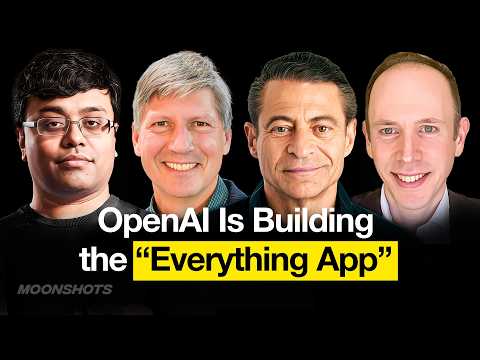
OpenAI vs. Grok: The Race to Build the Everything App w/ Emad Mostaque, Dave Blundin & AWG | EP #199
Peter DiamandisEmad MostaqueDave BlundinAlexander Wissner-Gross
OpenAI is emerging as a two-sided control point, combining more than 800 million weekly ChatGPT users with 4 million developers and 6 billion API tokens per minute.The everything-app race monetizes scarce attention through embedded services, agentic workflows, advertising, commerce, and likeness-driven media, while GPU supply, chip-fab capacity, and basic-chat commoditization remain key constraints.
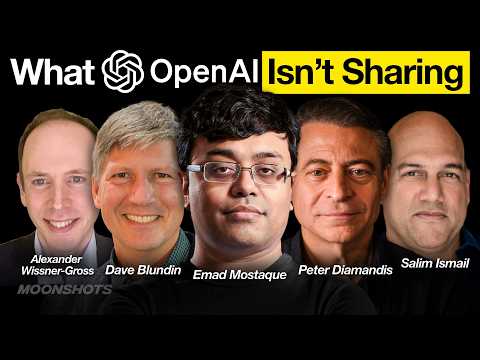
AI Insiders Breakdown the GPT-5 Update & What it Means for the AI Race w/ Emad, AWG, Dave & Salim
Peter DiamandisEmad MostaqueAlex Wissner-GrossDave BlundinSalim Ismail
GPT-5’s launch disappointed on presentation but expanded frontier access through routing, 700 million weekly users, coding parity with Anthropic, and API pricing falling from GPT-4.5’s $75 input and $150 output per million tokens to $1.25 and $10.The larger signal is intelligence hyperdeflation: GPT-5 Mini and Nano improve cost-performance, enabling more search and agentic work, while automation, frontier mathematics, open-weight models, infrastructure constraints, and Google’s response remain key variables to monitor.
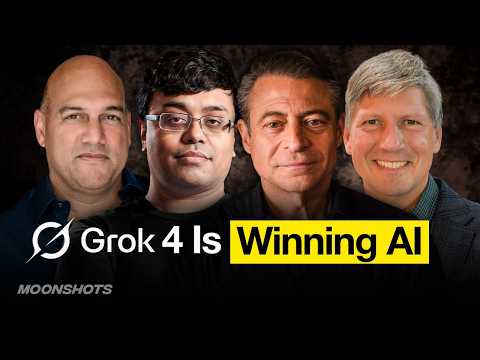
AI Experts React: Elon’s Grok 4 Is Now #1 in AI —This Changes Everything w/ Emad, Salim & Dave #182
Peter DiamandisEmad MostaqueSalim IsmailDave Blundin
Grok 4’s 100% AIME 2025 score and Grok 4 Heavy’s 44.4% on Humanity’s Last Exam shift competition toward planning, memory and usable agency as benchmarks approach saturation. xAI’s cited 340,000 GPUs and post-training compute parity show infrastructure and synthetic reasoning data becoming core advantages, while falling inference costs and unresolved mode collapse make agents, distribution and chip access the next variables.