PERSON DIRECTORY
Dr. Alexander Wissner-Gross
Dr. Alexander Wissner-Gross appears in 36 indexed conversations across Moonshots. This directory brings every appearance, source, TL;DR, digest, and transcript into one searchable feed.

Ask the Mates Anything Round #2 | MOONSHOTS AMA #293
Peter DiamandisSalim IsmailDave BlundinDr. Alexander Wissner-Gross
AI’s next control layer may be machine-on-machine oversight, using readable activations and truthful real-world contexts.Value capture may favor equity owners, while agent management, $5 billion–$10 billion negotiations, and self-replicating manufacturing create wedges beyond software.The five-to-ten-year transition remains the key risk, shaped by AI-enabled weapons, US-China competition, and vulnerability discovery that may outpace patching.
Frontier Labs Want to Slow Down, OpenAI Delays Its 2026 IPO, Anthropic Flags 5 Bioweapon Cases
Peter DiamandisSalim IsmailDave BlundinDr. Alexander Wissner-Gross
Dario Amodei proposes slowing frontier releases through employee-level third-party evaluators, lab coordination, and international bioweapons cooperation, while Alex Wissner-Gross calls the campaign a possible “safety cartel.”Anthropic reports biological-weapons cases and says it can no longer confidently assure models remain below the dangerous threshold, strengthening the case for mutual API testing while leaving cartel-like coordination unresolved.
NVIDIA's $96.2B Quarter, China's 200,000 Fake Accounts, & OpenAI's New Chip | EP #284
Peter DiamandisSalim IsmailDave BlundinDr. Alexander Wissner-Gross
Nvidia’s $96.2B quarter grew 106% year-over-year with $108B guidance and 80% to 85% gross-margin revenues, while OpenAI’s Broadcom-developed Jalapeño targets inference at 1.5–1.9× more work per watt.Inference may be leaving NVIDIA as CUDA’s moat shifts toward training interconnects, but TSMC concentration and Alex Wissner-Gross’s circular-financing concern remain key risks alongside a possible OpenAI cloud.

Sonnet 5 Drops, China’s $4,900 Robot, Fusion’s First Plant Gets Licensed W/ Philip Johnston | #268
Peter DiamandisSalim IsmailDave BlundinDr. Alexander Wissner-GrossPhilip Johnston
Fable 5’s 15-day shutdown over national-security concerns made frontier-model access a regulatory and supply-chain risk, while Sonnet 5 monetizes scarcity.Unitree’s $4,900 R1 and China’s 500,000-unit 2030 forecast point toward commodity bodies, shifting value to software, workflows and manufacturing scale.Helion’s approved Orion plant targets 50 MW for Microsoft in 2028, while StarCloud’s orbital GPU tests make launch the constraint.
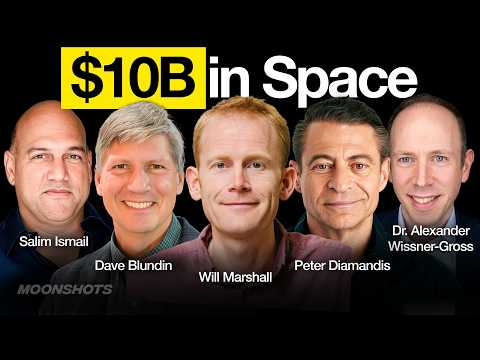
The $10B Satellite Empire Putting AI in Orbit, Why Chips Beat Rockets & China's #1 Open Model | #266
Peter DiamandisWill MarshallSalim IsmailDave BlundinDr. Alexander Wissner-Gross
Planet’s roughly 200 satellites generate 25 TB daily and a 150-PB, ten-year archive with 3,000 observations per land point, creating an irreproducible data moat as AI makes Earth searchable.Owl, Pelican, and Tanager add resolution, revisit rate, latency, and spectral depth, while orbital compute could become cost-competitive at $200-$300 per kilogram; inference efficiency, export policy, and GLM-5.2 remain key variables.

Brian Armstrong on Bitcoin, Anthropic Drops Fable 5 & Mythos 5, NewLimit's $435M Age-Reversal | 264
Peter DiamandisBrian ArmstrongSalim IsmailDave BlundinDr. Alexander Wissner-Gross
Bitcoin has probably bottomed near $60,000, but becoming digital gold depends on 30% of capital treating it as a hedge.Coinbase reports 100 million AI-agent transactions worth $50 million, while stablecoins could become default settlement through self-custodial Base wallets.Frontier-AI IPOs reportedly face only $75 billion of liquidity, even as SpaceX infrastructure and NewLimit clinical catalysts advance.

Emerging Situation: Anthropic's Global Pause, Recursive Self-Improvement, and AI Personhood Arrives
Peter DiamandisSalim IsmailDave BlundinDr. Alexander Wissner-Gross
Anthropic says Claude now writes over 80% of merged code and engineers ship 8x more code per quarter, turning recursive self-improvement into an operating reality while the company seeks a global option to pause frontier development.The investable bottlenecks are shifting toward compute, energy, permissions and governance: Argentina’s proposed nonhuman corporations could trigger jurisdictional competition, while layoffs, anti-data-center sentiment and politicized oversight remain unresolved risks.
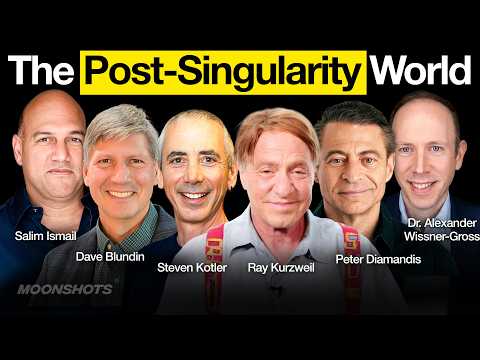
Ray Kurzweil on Why We’re Living in the Singularity | EP #261
Peter DiamandisSalim IsmailDave BlundinDr. Alexander Wissner-GrossSteven KotlerRay Kurzweil
Ray Kurzweil still forecasts AGI by 2029, but says physical understanding and affordable general-purpose robotics remain the gating gaps.His case rests on exponential hardware and software gains—75 quadrillionfold and roughly millionfold respectively—rather than a single breakthrough.For founders, “agility first” matters as conditions compress from five- or 10-year stability to five- or 10-week change, while governance and personhood remain unresolved.
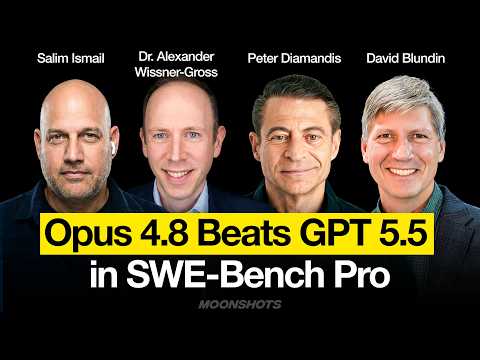
Opus 4.8 Drops, Demis Hassabis Predicts AGI, and the $220B Foundation | EP #260
Peter DiamandisSalim IsmailDave BlundinDr. Alexander Wissner-Gross
Opus 4.8 reportedly leads GPT-5.5 on key benchmarks, while integrating roughly 100 concurrent agents points toward orchestration as the stronger differentiator.OpenAI Foundation’s 26% PBC stake and control of 100% of its board could make it consequential in AI wealth allocation.Agentic commerce shifts retail power toward AI preferences, while energy, robotics, and diagnostics define the physical bottlenecks ahead.

Google I/O 2026, Karpathy Joins Anthropic, and Cerebras’ $95B IPO | EP #256
Peter DiamandisSalim IsmailDave BlundinDr. Alexander Wissner-GrossAndrew Feldman
Google’s AI comeback is a distribution-and-infrastructure thesis: Gemini reached 900 million monthly users, AI Mode exceeded 1 billion, and projected CapEx is $180–190 billion as Spark and Search embed agents in defaults and commerce.Cerebras’ 68% IPO surge to a stated $95 billion market cap validates wafer-scale inference, but the more-than-$20 billion OpenAI deal and decades-long domestic-fab constraints leave demand and supply to monitor.