PERSON DIRECTORY
Ben Thompson
Host of Sharp Tech. Ben Thompson appears in 68 indexed conversations across Sharp Tech, Invest Like the Best. This directory brings every appearance, source, TL;DR, digest, and transcript into one searchable feed.
(Preview) A Summer Break Mailbag: Memory Mania, Vibe Coding, Mafia PR, Caffeine Intake, Garages, and How to Fix Soccer
Apple’s mid-cycle Mac price increases suggest it missed the memory shock in both procurement and pricing, while delayed Siri may arrive in 2026 with 2024-era capabilities.As major suppliers prioritize HBM, DRAM scarcity could let Chinese producers climb the learning curve profitably, with export controls potentially accelerating that competition.Vibe coding makes highly bespoke software viable: an AI assistant catalogs household objects, recognizes roughly 95% from photos, and links them to locations through QR codes.
(Preview) Inference in the Agentic Future, xAI Is Two Companies in One, Q&A on Elon’s Lawsuit, Intel, Apple
Fast inference retains a premium while humans supervise agents, but longer autonomous runs shift the bottleneck toward KV-cache capacity and tiered memory.Cerebras and Groq show the premium persists for voice and consumer responsiveness, but off-chip memory can make performance “totally plummet.”That favors slower, cheaper commodity infrastructure and potentially China, while challenging NVIDIA’s integrated inference economics without displacing its training advantage.
AWS History and Trainium's AI Future; OpenAI's Microsoft Deal
AWS’s 28% growth and expanding margins reinforce its cost-led cloud strategy, combining custom silicon, service breadth and lock-in to turn infrastructure efficiency into pricing power.Large-scale training still favors NVIDIA’s tightly connected data-center architecture, but cheaper, more efficiently utilized inference could make Trainium and AWS’s commodity economics a stronger AI catalyst.
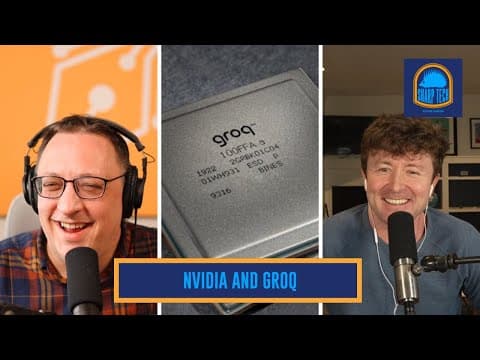
What Nvidia Is Getting From Groq | Sharp Tech with Ben Thompson
Groq’s compiler-first, SRAM-based architecture delivers extremely fast inference but only 256 megabytes of memory per chip, creating a sharp trade-off between latency-sensitive applications and context-intensive workloads.Nvidia’s licensing and hiring arrangement could turn that niche into a software- and supply-chain-enabled platform, though the non-acquisition structure also highlights an antitrust regime that may make consequential deals easier to avoid reviewing.
The Hidden Benefits of Bubble Economics and the Microsoft-OpenAI Deal
Substrate’s particle-accelerator-powered X-ray lithography claims could halve chip-manufacturing costs, but consistent sources and compatibility with doping remain unproven.Because lithography anchors the fab’s surrounding processes, replacing ASML’s tool may require rebuilding etching, coating, and doping integration from first principles.Bubble-era capital is financing this 1% possibility alongside thermodynamic-chip experiments, while ASML and TSMC’s co-evolution keeps the incumbent system deeply locked in.
Why Nvidia Wants to Sell Chips to China, Answering Intel Objections, KPop Demon Hunters Conquers the World
Nvidia’s $46.7 billion July-quarter sales and $54 billion Q3 guide cannot reveal underlying AI demand while GPU supply remains constrained, while selling H20s into China could prevent a domestic CUDA replacement from spreading globally and weakening Nvidia’s moat.The US 10% Intel stake preserves foundry knowledge that cannot be rebuilt quickly, but dilution and governance risks remain, while rare earths and semiconductor controls show the unresolved tension between economically rational globalization and national-security resilience.
Intel and the US Semi Future, Will Any Big Tech Incumbents Lose in an AI World?, Questions on Tea, Grok, and The Ringer
Intel’s 14A disclosure makes its capital constraint explicit: without a meaningful external customer, internal products cannot support the node’s returns, while its integrated culture remains poorly suited to outside foundry clients.Samsung’s $16.5 billion Tesla deal could anchor a second US leading-edge supplier, improving resilience before Intel recovers; Google Cloud’s AI growth likewise shows incumbents can fund competition, though margins and OpenAI’s financing remain unresolved.
AI Promises and Chip Precariousness, Policy Recommendations and a Changing World, Concerns and Counterpoints
Ben Thompson recommends lifting restrictions on finished chips while sharply tightening controls on semiconductor equipment, aiming to preserve another 10 to 15 years of shared dependence on TSMC and Taiwan.The tradeoff is explicit: China could obtain AI systems equal to or better than America’s, while stricter equipment controls could eventually erode Western manufacturing leadership and still fail to change Xi Jinping’s Taiwan calculus.
(Preview) Xi and China's Tech, the Chip Ban, and Pessimism on Taiwan
DeepSeek showed a chip-constrained company could build an internationally competitive open-source model, globalizing distribution and pushing Chinese providers toward free offerings.The $6 million figure covered one training run, not experimentation or R&D, leaving the business model unclear.Whether ingenuity can offset restricted hardware over one or two years remains unresolved as xAI and OpenAI keep buying better NVIDIA systems.
The End of DeepSeek Week: Moneyball for AI, The Future of Compute Demand, Geopolitical Reality Checks, and More
DeepSeek is Moneyball for AI: its $6 million V3 figure covered one final run, while mixture-of-experts and low-level optimization delivered efficiency breakthroughs without surpassing the US frontier.Cheaper reasoning models may manufacture training data and expand aggregate compute demand, preserving opportunities in power, networking, cooling, and inference; Microsoft retains optionality as export controls gamble on a durable US lead despite China’s industrial strengths.