PERSON DIRECTORY
Ben Gilbert
Host of Acquired. Ben Gilbert appears in 20 indexed conversations across Acquired. This directory brings every appearance, source, TL;DR, digest, and transcript into one searchable feed.
Home Depot: The best-performing stock in the S&P 500 since IPO (Audio)
Home Depot’s extraordinary compounding rests on a differentiated specialty-retail system: tradespeople, 25,000 SKUs, supplier-financed inventory, and scale that once produced four times Lowe’s transactions.With 51% of a $300 billion market and a 42-year median U.S. home age, its logistics moat supports 2–24-hour delivery, while SRS integration and paused buybacks remain key milestones to monitor.
Disney: The Renaissance and the Empire
Disney’s golden ages depended on the cable bundle, packed theaters, and home video—structural cushions now gone, leaving parks to carry nearly 60% of operating income.ESPN’s $9.42 monthly affiliate fee funded Pixar, Marvel, and Lucasfilm, while Disney+ produces about $1B on $25B revenue versus Netflix’s $13.5B on $45B.With $60B of parks capex ahead, investors must weigh pricing power and unscaled capacity against franchise exhaustion and the possibility that Disney’s luxury-brand myths recover.
The Walt Disney Company: The most successful enterprise for monetizing human nostalgia (Audio)
Disney’s durable business is compounding owned IP across films, merchandise, television, re-releases, and parks, not theatrical production alone; the 1928 loss of Oswald taught Walt that creation without ownership leaves enterprise value near zero.Snow White and Disneyland showed how high-risk creative and engineering bets could be financed and monetized through ancillary revenue, while Walt’s death showed that installed IP can mask creative decay if new beloved characters do not emerge.
Ferrari: What happens when you staple a luxury brand to a sports team? (Audio)
Ferrari’s 13,640 cars generated $8.2 billion of revenue, $3.2 billion of EBITDA, a 38.8% EBITDA margin, and roughly 50% gross margins by selling scarcity and identity rather than transportation.Existing-client demand, orders booked through 2027 and perhaps early 2028, and a 20% Purosangue cap protect the myth, while 5% annual revenue guidance, China, merchandise dilution, and the unproven Luce EV remain key risks.
Formula 1: Fast cars, celebrities, and B2B software (Audio)
Liberty Media turned Formula 1 into an investable global sports platform, lifting it from a $4.4 billion equity acquisition in 2017 to roughly $22 billion market capitalization by 2026 while reinvesting in distribution and fan growth.The cost cap transformed teams from recurring financial casualties into scarce franchises valued above $1 billion, but already-rich valuations and the unresolved “parade than a race” problem make sporting improvements and monetization per fan key catalysts to monitor.

Costco (Audio)
Costco’s roughly $230 billion revenue model combines about 3,800 SKUs, 14% ordinary markups, 12.4 inventory turns, and negative cash conversion to share scale economies with customers.Membership fees generate about 70% of operating income, 93% of US members renew, and executive members drive 73% of sales, while international expansion and warehouse constraints define the runway.
Coca-Cola: The Complete History & Strategy (Audio)
Coca-Cola’s durable advantage is a capital-light system combining brand, scale, advertising, and bottler incentives, created when its 1899 contract shifted plants, bottles, trucks, and distribution investment onto roughly 200 partners.That architecture enabled global ubiquity and exceptional cash generation, but Pepsi’s counterpositioning, missed categories, modest 3–4% post-1998 growth, health concerns, and a roughly 10% annualized long-term return keep execution and saturation in focus.
The Steve Ballmer Interview
Ben GilbertDavid RosenthalSteve Ballmer
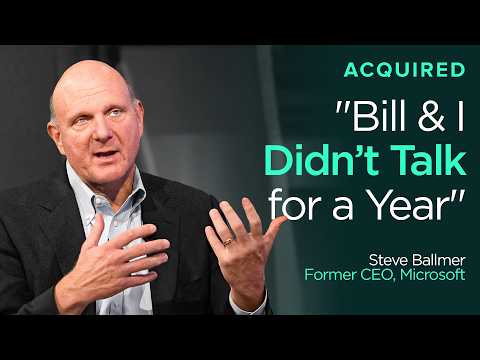
Microsoft turned DOS, Windows, Office, Exchange and Active Directory into an enterprise stack that sold peace of mind through three-year recurring agreements, then incubated Azure to capture customer hardware and labor spending.The company’s “Windows Everywhere” mindset missed mobile and search, while cloud succeeded through protected development and accumulated capability; Microsoft’s future depends on sustaining independent locomotives rather than extending legacy franchises.
Indian Premier League Cricket (Audio)
The IPL became a more-than-$16 billion league in 17 years by converting cricket into nightly, three-hour prime-time entertainment, generating roughly $16–17 million per match in media rights.The BCCI’s control of Indian players, media rights and international access created a defensible choke point, while asset-light franchises, equal central revenue and auctions supported parity and attractive margins.Further teams, games, mobile distribution and cricket’s 2028 Olympic return could support NFL-scale economics, but the Reliance–Disney merger, streaming competition, governance and the BCCI’s 50% take remain key risks.