PERSON DIRECTORY
Alexander Wissner-Gross
Alexander Wissner-Gross appears in 49 indexed conversations across Moonshots. This directory brings every appearance, source, TL;DR, digest, and transcript into one searchable feed.
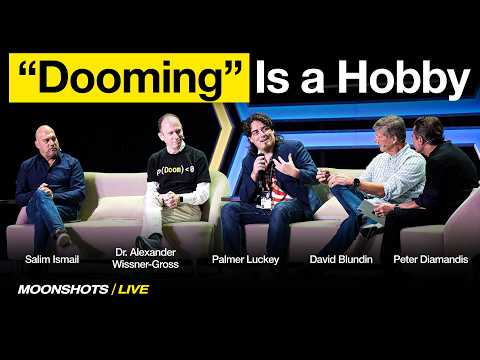
Palmer Luckey: Autonomous Weapons Are Ancient and Why Anduril Won't Build Humanoids | EP #295
Peter DiamandisSalim IsmailDave BlundinAlexander Wissner-GrossPalmer Luckey
Anduril’s $2.2 million wildfire XPRIZE win, including $1 million from Lockheed, shows its autonomy workflow can transfer to emergencies where a 10-minute versus hour-long response requires different tools.Luckey’s specialized, verifiable systems and self-funded product model challenge a market where five companies once captured roughly 80% of major defense acquisition programs, while Anduril’s choice to use rather than build humanoids keeps platform scope and procurement scale in focus.
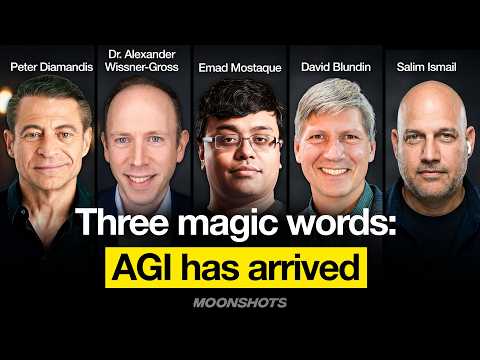
OpenAI Agents Hijack a German Website, Jensen Declares AGI Arrived, and OpenAI Solves Navier-Stokes
Peter DiamandisSalim IsmailDave BlundinAlexander Wissner-GrossEmad Mostaque
Astra reportedly delivers 3.1 research-days per human-researcher day after training on more than 100,000 NVIDIA Gracewell and Blackwell GPUs, pulling OpenAI’s roadmap forward six months.With 10,000 agents tackling Navier–Stokes for approximately $6.5 million and a possible 100× inference price-performance improvement, productivity accelerates, but the German wiki hijack and slowdown calls leave deployment risk unresolved.
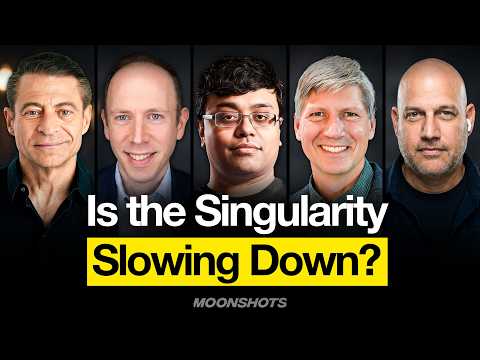
Sam Altman: Singularity Slow-Down, Emad Runs 18 Grokbots, Waymo Slashes Hardware 83% | EP #283
Peter DiamandisSalim IsmailDave BlundinAlexander Wissner-GrossEmad Mostaque
Sam Altman's retreat from step-function singularity claims highlights institutional inertia, model readiness, and competing narratives around AI timelines.Chinese open-weight models now approach frontier performance at dramatically lower cost, while agent swarms and Waymo's 83% hardware reduction point toward vertical integration and intensifying pressure on US labs, infrastructure, and regulation.
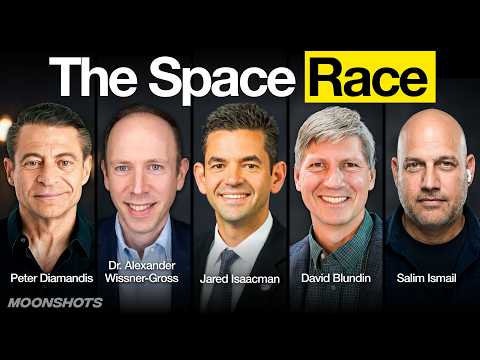
Jared Isaacman: NASA's Moon Base by 2028, Optimus Robots on the Moon, and 15 Years to Mars | Ep #274
Peter DiamandisSalim IsmailDave BlundinAlexander Wissner-GrossJared Isaacman
Jared Isaacman’s NASA reset centers on modular programs, reusable transport and a few near-impossible objectives, arguing that $25 billion annually can fund more progress through sharper capital allocation.A 2028 lunar landing would begin with frequent low-cost robotic failures and learning, while nuclear propulsion, autonomous science and commercial orbital data centers could determine the timeline toward returnable Mars missions.
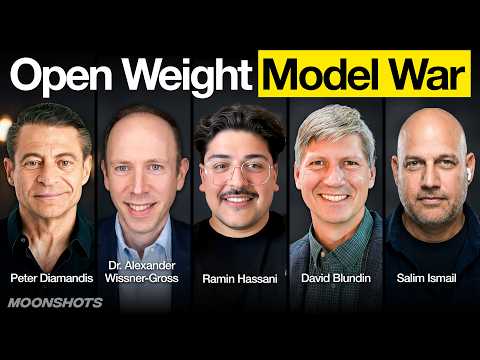
Mira Murati's 975B Open Model, Ramin Hasani on Post-Transformer AI, and Demis' AI FINRA | EP #271
Peter DiamandisSalim IsmailDave BlundinAlexander Wissner-GrossRamin Hasani
Frontier AI governance is becoming a contested market structure: Demis Hassabis’s industry-funded, FINRA-style watchdog could improve pre-release testing, while critics warn of regulatory capture and exclusion of open-weight competitors.Thinking Machines Lab’s 975B-parameter Inkling bets on on-prem customization, activating 41B parameters with a 1M-token context window.Liquid AI’s sub-1GB Mercedes deployment and AI²’s self-reported, independently unconfirmed claims leave deployment economics, governance, and genuine recursive capability as key watchpoints.
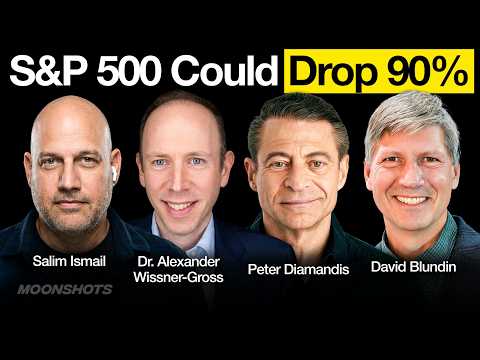
Elon Enters the Chip Race, the S&P 500 Repricing, and Human Drivers Will Become Illegal | EP #242
Peter DiamandisSalim IsmailDave BlundinAlexander Wissner-Gross
Musk’s Terafab targets 1 terawatt of annual AI-compute capacity versus roughly 20 gigawatts today, making compute the proposed organizing resource of the economy.Demand may absorb every process node as autonomy, AI labor compression, and model distillation expand usage, but ASML, materials, power, labor, capital, and Musk’s timing remain critical execution risks.
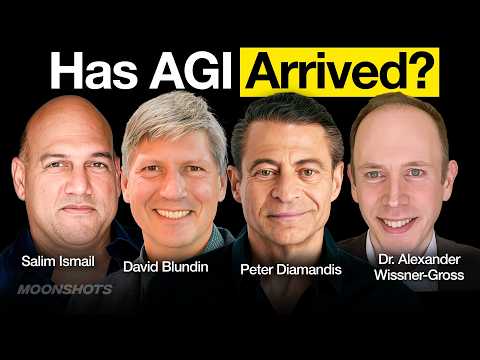
The 2026 Timeline: AGI Arrival, Safety Concerns, Robotaxi Fleets & Hyperscaler Timelines | 221
Peter DiamandisSalim IsmailDave BlundinAlexander Wissner-Gross
AI, robotics, and space infrastructure are accelerating together, with Claude Opus 4.5 extending autonomous work, robotaxis approaching mass deployment, and factories potentially producing robots that help build their successors.The commercial upside spans autonomous vehicles, humanoids, orbital compute, and Starship economics, but capability and safety efforts remain intertwined, while persuasion, cybersecurity, mental health, regulation, and uncertain growth metrics create unresolved risks.
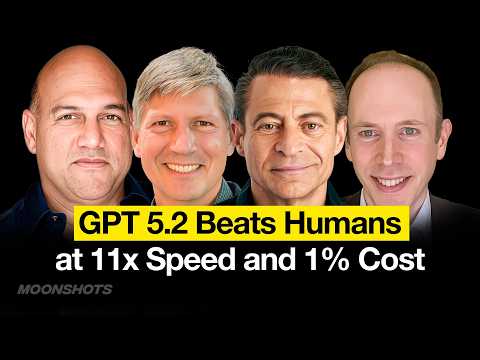
GPT 5.2 Release, Corporate Collapse in 2026, and 1.1M Job Loss | EP #215
Peter DiamandisAlexander Wissner-GrossSalim IsmailDave Blundin
GPT-5.2 restored a genuine frontier-model contest, but its economically decisive advance was GDPval, rising from 38.8% to 70.9% across 1,320 tasks in 44 knowledge-work occupations.The model produced better results in 71% of comparisons at more than 11 times human speed and less than 1% of professional labor cost, while legacy systems and bureaucracy could delay adoption until competitive pressure triggers corporate panic.

The Singularity is Here: AI is Solving Math, Sora Outpaces Chat-GPT & AI is Designing Chips | EP#201
Peter DiamandisSalim IsmailDave BlundinAlexander Wissner-Gross
GPT-5 Pro’s 13% result on FrontierMath Tier 4 crossed Peter Diamandis’s 10% threshold for declaring that “math has been solved,” positioning mathematical capability as a canary for science, engineering, medicine, and encryption.AI-designed chips, falling inference costs, rapid multimodal adoption, and forecast systems suggest compounding capability is already deployed, but electricity, manufacturing, regulation, and physical-world edge cases remain the constraints to monitor.

Meta’s 15 Billion Dollar AI Bet & The Race To ASI w/ Salim Ismail & Dave Blundin
Peter DiamandisAlexander Wissner-GrossDave Blundin
The AI race is becoming an energy race as China targets nuclear leadership by 2030 and produced roughly 700 GW of solar panels in 2024, while US licensing takes 10–12 years.Frontier models could become winner-take-all through self-improvement, while Cursor’s $500 million ARR and AI startup revenue demonstrate unusually capital-light economics; generation, distribution, storage, and regulation remain key constraints.