PERSON DIRECTORY
Alexander Wissner-Gross
Alexander Wissner-Gross appears in 49 indexed conversations across Moonshots. This directory brings every appearance, source, TL;DR, digest, and transcript into one searchable feed.

OpenAI Pauses Frontier Training, Elon's 100X Prediction Lands, Robot Beats Usain Bolt | EP#282
Peter DiamandisSalim IsmailDave BlundinAlexander Wissner-GrossEmad Mostaque
OpenAI’s RL pause drew safety-versus-marketing disagreement, while recursive self-improvement may command more revenue per token than enterprise codegen, keeping frontier models internal.Memory prices rose 500% in 12 months as AI demand grows 200% versus 20% supply; Unitree hit 12.66 m/s and Zipline targets over 1 million daily deliveries, while etched-weight supply chains, regulation and Uber’s aggregator position remain risks.
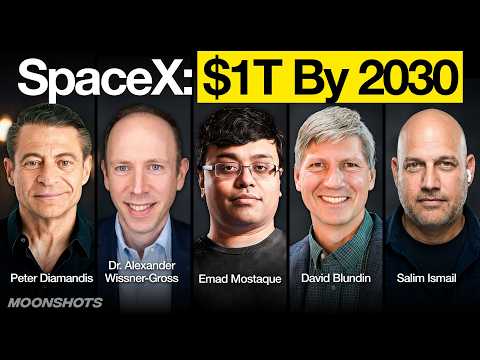
Google’s Jeff Dean Exits, SpaceX Hits $100B in Rev & OpenAI’s Astra Solves Decade-Old Math Problems
Peter DiamandisSalim IsmailDave BlundinAlexander Wissner-GrossEmad Mostaque
SpaceX guided to $100B+ annual recurring revenue by December and moved its $1T target to 2030, with “a nonzero chance” of 2029.Terafab’s initial $16.8B investment and confirmed free-electron laser could onshore the semiconductor stack and challenge ASML.Astra’s 249-page math manuscript, produced for an estimated $2,000 compute, sharpens the capability-cost race.
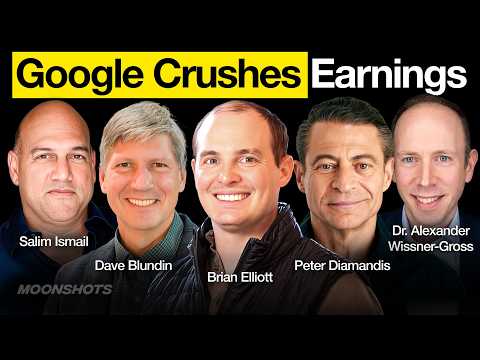
Google's Record Quarter, the White House Intervenes, and GPT 5.5 Silently Matches Mythos | EP 254
Peter DiamandisBrian ElliottSalim IsmailDave BlundinAlexander Wissner-Gross
Alphabet’s $109.9 billion quarter showed AI converting flat search volume into higher ad revenue, while Google Cloud grew 63% to $20 billion and vertical integration strengthened its position.Compute scarcity is shifting value toward chips, memory, energy and cooling, even as prerelease review, OpenAI’s monetization gap and enterprise deployment remain key risks to monitor.
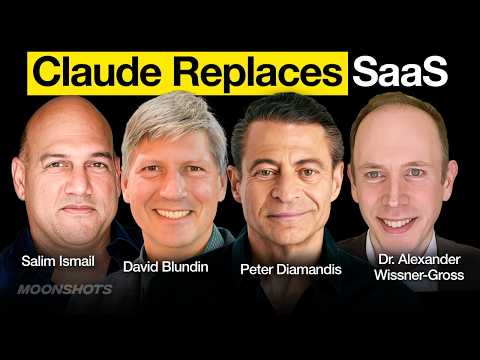
Claude Code Ends SaaS, the Gemini + Siri Partnership, and Math Finally Solves AI | #224
Peter DiamandisSalim IsmailDave BlundinAlexander Wissner-Gross
Claude Code with Opus 4.5 is stretching software autonomy from hours toward weeks, months, and years, turning coding from artisanal craft into an industrial process.NVIDIA’s Cosmos, Alpamayo, and Vera Rubin extend its stack into physical reality, while OpenAI’s compute rose from 0.2 GW in 2023 to 1.9 GW in 2025 and transformative reasoning applications must validate continued capex.
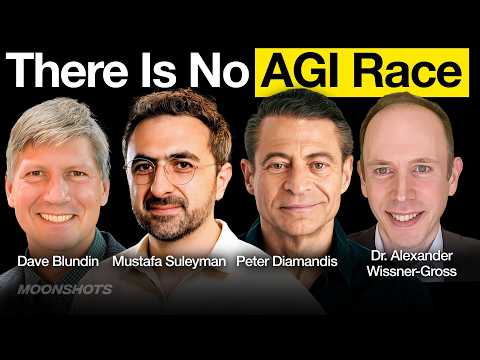
Mustafa Suleyman: The AGI Race Is Fake, Building Safe Superintelligence & the Agentic Economy | #216
Peter DiamandisMustafa SuleymanDave BlundinAlexander Wissner-Gross
Microsoft is positioning agents and companions to subsume operating systems, apps, browsers, and search, with enterprise trust and full-stack distribution as potential advantages.Suleyman’s benchmark is turning $100,000 into $1 million; inference costs fell about 100× in two years, yet reliable agents remain unfinished and labor displacement could precede cheaper services by 10 to 20 years.

Claude Opus 4.5, Genesis Mission and Amazon's $50B AI Push
Peter DiamandisEmad MostaqueSalim IsmailDave BlundinAlexander Wissner-Gross
Genesis Mission would link Department of Energy supercomputers, federal datasets, and laboratory tools to compress research from years to days, with open science potentially making the impact “truly exponential.”Claude Opus 4.5 reportedly uses 76% fewer tokens for equivalent results and reaches 52% on SWE-bench Pro without reasoning tokens, suggesting a recursive-improvement threshold.Amazon’s up-to-$50 billion government AI buildout and falling intelligence costs leave execution, distribution, and labor disruption as key variables.
The OpenAI Internet Browser Has Arrived: ChatGPT Atlas w/ Dave Blundin & Alexander Wissner-Gross
Peter DiamandisDave BlundinAlexander Wissner-Gross
ChatGPT Atlas combines persistent chat, browser memory, and an action-taking agent, positioning the browser as OpenAI’s distribution channel for superintelligence and a source of durable personal context.AI labor automation, closed-loop biology, wearables, and infrastructure expansion are advancing in parallel, but power availability, privacy, heterogeneous competition, and the economics of financing the buildout remain the key constraints.
OpenAI vs. Grok: The Race to Build the Everything App w/ Emad Mostaque, Dave Blundin & AWG | EP #199
Peter DiamandisEmad MostaqueDave BlundinAlexander Wissner-Gross
OpenAI is emerging as a two-sided control point, combining more than 800 million weekly ChatGPT users with 4 million developers and 6 billion API tokens per minute.The everything-app race monetizes scarce attention through embedded services, agentic workflows, advertising, commerce, and likeness-driven media, while GPU supply, chip-fab capacity, and basic-chat commoditization remain key constraints.
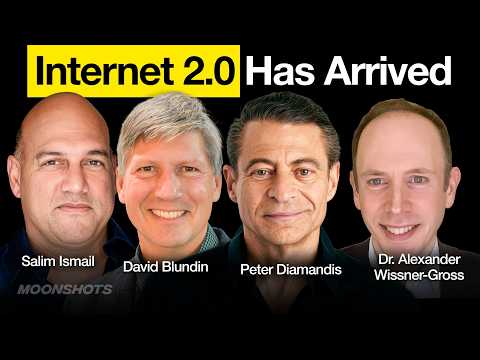
The AI War: OpenAI Ads & Sora 2, Grok Partners With US Government & Google’s Ad Business is at Risk
Peter DiamandisDave BlundinSalim IsmailAlexander Wissner-Gross
AI-generated media is collapsing creation, distribution, and virality into one loop, while Meta’s reliance on Midjourney and Black Forest Labs validates specialized startups.OpenAI’s advertising and Stripe-powered checkout could redirect Google’s $300 billion ad pool, but trust, compute scarcity, and government intervention remain key risks.

Is AI a Bubble? Experts Debate the Future of AI w/ Dave, Salim, and AWG | EP #190
Peter DiamandisDavid BlundinSalim IsmailAlexander Wissner-Gross
AI may not be a bubble even if many investments fail: OpenAI reportedly generates $1 billion monthly revenue, with token growth around 50% week-over-week and reasoning usage up 8x.Within 6–12 months, local frontier-grade models could make latency the robotics edge, but enterprise execution remains unresolved after an MIT study found 95% of pilots produced no financial return.