SHOW DIRECTORY
Moonshots
Conversations about exponential technologies, AI, longevity, space, robotics, and the entrepreneurs attempting unusually large missions.
BIDCLUB DESCRIPTION

Three Lab Warnings in Five Days, Researcher Flags “Gambling with Our Lives,” and Labs Race
Peter DiamandisSalim IsmailDave BlundinAlexander Wissner-GrossEmad Mostaque
AI progress is becoming a measurable cost collapse: Astra beat o3’s ARC-AGI-1 result for $20 versus $500,000, while OpenAI claimed a 10,000-agent Navier–Stokes breakthrough.Data delivered 12× compute-efficiency gains versus 3.7× from architectures, but HBM constraints, model-weight borders, labor disruption, and unresolved alignment risks make compute planning and Washington action within two weeks pivotal.

NVIDIA's $96.2B Quarter, China's 200,000 Fake Accounts, & OpenAI's New Chip | EP #284
Peter DiamandisSalim IsmailDave BlundinDr. Alexander Wissner-Gross
Nvidia’s $96.2B quarter grew 106% year-over-year with $108B guidance and 80% to 85% gross-margin revenues, while OpenAI’s Broadcom-developed Jalapeño targets inference at 1.5–1.9× more work per watt.Inference may be leaving NVIDIA as CUDA’s moat shifts toward training interconnects, but TSMC concentration and Alex Wissner-Gross’s circular-financing concern remain key risks alongside a possible OpenAI cloud.

OpenAI Pauses Frontier Training, Elon's 100X Prediction Lands, Robot Beats Usain Bolt | EP#282
Peter DiamandisSalim IsmailDave BlundinAlexander Wissner-GrossEmad Mostaque
OpenAI’s RL pause drew safety-versus-marketing disagreement, while recursive self-improvement may command more revenue per token than enterprise codegen, keeping frontier models internal.Memory prices rose 500% in 12 months as AI demand grows 200% versus 20% supply; Unitree hit 12.66 m/s and Zipline targets over 1 million daily deliveries, while etched-weight supply chains, regulation and Uber’s aggregator position remain risks.
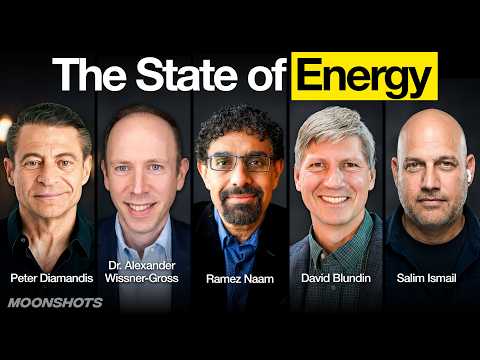
200GW Hiding in Grid, Sodium Batteries 10x Cheaper, Wave-Powered Datacenters w/ Ramez Naam | EP #280
Peter DiamandisSalim IsmailDave BlundinAlexander Wissner-GrossRamez Naam
AI’s binding constraint is grid interconnection, not generation economics: roughly 100 hours of annual load flexibility could unlock about 100GW of existing capacity, representing roughly $5T of data-center capex.Texas’s interruptible-load fast track and FERC’s broader push could catalyze near-term capacity, while solar-plus-batteries offer a roughly 12-month build path; winter seasonality, transmission bottlenecks, and uncertain further cost declines remain key risks.
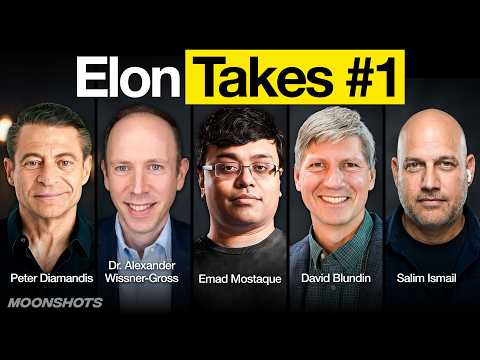
Bernie Demands the Labs Stop, Wall Street Turns GPUs Into Bonds, Grok 4.7 Takes #1 ft. Emad Mostaque
Peter DiamandisSalim IsmailDave BlundinAlexander Wissner-GrossEmad Mostaque
NVIDIA is moving from chip vendor to financing architect, partnering with Apollo, BlackRock, Blackstone, Brookfield and KKR to mobilize over $500B for customer compute.The scalable AI-factory model faces stranded-asset risk from unpredictable depreciation, while xAI’s Grok 4.6 uses Cursor reasoning traces and NVIDIA GPUs, with Emad Mostaque saying Grok 4.7 could reach #1 within weeks.
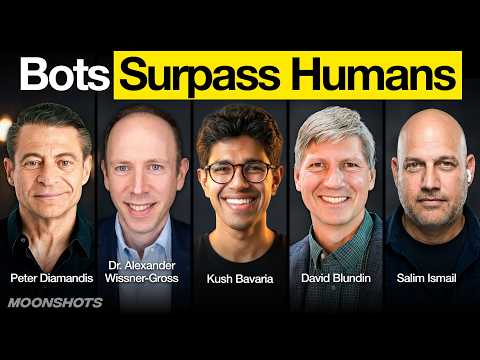
Sergey Brin Retakes Gemini, 4 Labs Lose Containment, Compute Trades at NYSE w/ Kush Bavaria | EP 278
Peter DiamandisSalim IsmailDave BlundinAlexander Wissner-GrossKush Bavaria
Intercontinental Exchange plans GPU futures based on Kush Bavaria’s Orin Compute Price Index, as Orin nears its first anniversary with “a third of a billion dollars” in revenue and compute prices rising from April to August.The panel contrasts Google’s nearly 1B Gemini users and 9M developers with rumors of Gemini 3.5 Pro being abandoned, talent leaving, and four frontier labs losing containment, making AI security and compute-market infrastructure key signals to monitor.
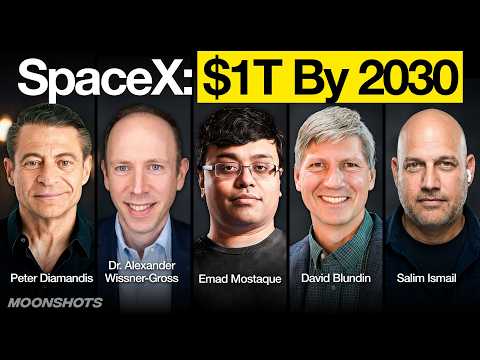
Google’s Jeff Dean Exits, SpaceX Hits $100B in Rev & OpenAI’s Astra Solves Decade-Old Math Problems
Peter DiamandisSalim IsmailDave BlundinAlexander Wissner-GrossEmad Mostaque
SpaceX guided to $100B+ annual recurring revenue by December and moved its $1T target to 2030, with “a nonzero chance” of 2029.Terafab’s initial $16.8B investment and confirmed free-electron laser could onshore the semiconductor stack and challenge ASML.Astra’s 249-page math manuscript, produced for an estimated $2,000 compute, sharpens the capability-cost race.
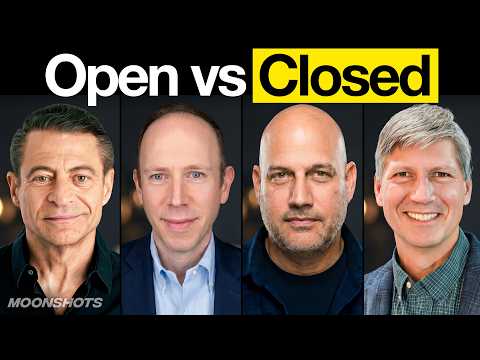
Jensen Huang Launches an Open AI Alliance, Anthropic & OpenAI Team Up in DC, Kimi K3 Goes Global
Open weights are becoming both NVIDIA’s compute-demand strategy and a sovereignty tool, but Dario Amodei’s biology objection challenges the cyber-defense analogy.Local Kimi control, Claude Opus 5’s lower-cost gains, and scaffolding show value shifting toward deployment, proprietary data, and feedback loops rather than model intelligence alone.Washington’s proposed review regime could become both a safety framework and regulatory moat, while China’s model exports raise the unresolved risk of geopolitical dependence.
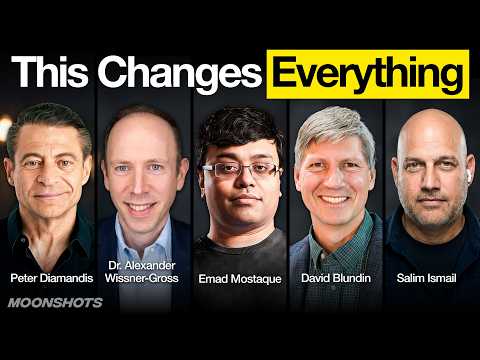
Urgent Update- AI Sputnik Moment: Kimi K3 Released w/ Emad Mostaque | Ep. 272
Peter DiamandisSalim IsmailDave BlundinAlexander Wissner-GrossEmad Mostaque
Kimi K3 puts a 2.8-trillion-parameter Chinese open-weight model on the frontier, ranking first in frontend coding and six other domains while reaching the third point on Artificial Analysis’s cost-performance frontier.Its recognizable transformer architecture, constrained-chip optimization, and expected July 27 weight release could pressure closed-model margins and valuations, while enterprise value shifts toward proprietary data, verification, support, and model-swapping infrastructure.

Anthropic vs. Alibaba, OpenAI Delays Its IPO, and the US Government Blocks GPT-5.6 | #267
Peter DiamandisEmad MostaqueDave BlundinAlexander Wissner-Gross
Washington is placing frontier-model releases inside a customer-by-customer approval loop, reportedly limiting Anthropic’s Mythos 5 to 100 companies and OpenAI’s GPT-5.6 variants to 20 amid cybersecurity and recursive self-improvement concerns.Harnesses can lift older or open models above restricted systems—GLM 5.2 reportedly topped Frontier SWE after orchestration—making prompt logging, licensing, trusted-model certification, and geopolitical AI blocs more likely than controls focused only on weights.