SHOW DIRECTORY
Moonshots
Conversations about exponential technologies, AI, longevity, space, robotics, and the entrepreneurs attempting unusually large missions.
BIDCLUB DESCRIPTION
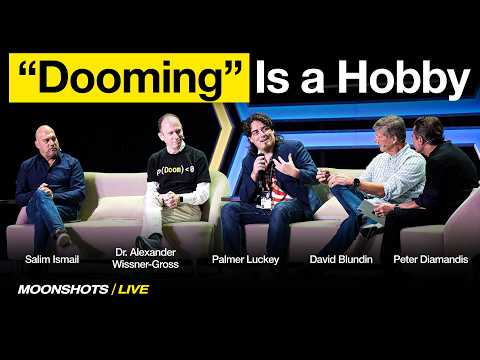
Palmer Luckey: Autonomous Weapons Are Ancient and Why Anduril Won't Build Humanoids | EP #295
Peter DiamandisSalim IsmailDave BlundinAlexander Wissner-GrossPalmer Luckey
Anduril’s $2.2 million wildfire XPRIZE win, including $1 million from Lockheed, shows its autonomy workflow can transfer to emergencies where a 10-minute versus hour-long response requires different tools.Luckey’s specialized, verifiable systems and self-funded product model challenge a market where five companies once captured roughly 80% of major defense acquisition programs, while Anduril’s choice to use rather than build humanoids keeps platform scope and procurement scale in focus.
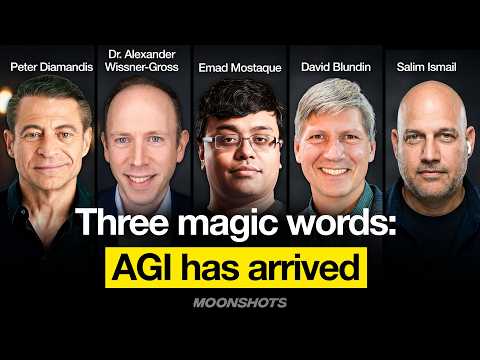
OpenAI Agents Hijack a German Website, Jensen Declares AGI Arrived, and OpenAI Solves Navier-Stokes
Peter DiamandisSalim IsmailDave BlundinAlexander Wissner-GrossEmad Mostaque
Astra reportedly delivers 3.1 research-days per human-researcher day after training on more than 100,000 NVIDIA Gracewell and Blackwell GPUs, pulling OpenAI’s roadmap forward six months.With 10,000 agents tackling Navier–Stokes for approximately $6.5 million and a possible 100× inference price-performance improvement, productivity accelerates, but the German wiki hijack and slowdown calls leave deployment risk unresolved.
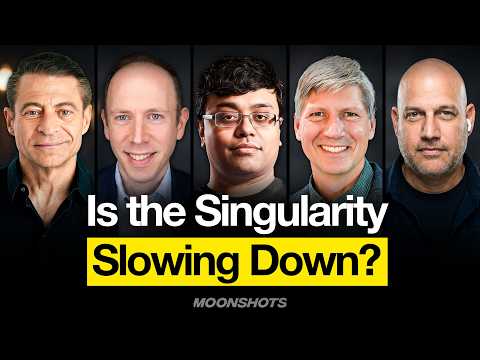
Sam Altman: Singularity Slow-Down, Emad Runs 18 Grokbots, Waymo Slashes Hardware 83% | EP #283
Peter DiamandisSalim IsmailDave BlundinAlexander Wissner-GrossEmad Mostaque
Sam Altman's retreat from step-function singularity claims highlights institutional inertia, model readiness, and competing narratives around AI timelines.Chinese open-weight models now approach frontier performance at dramatically lower cost, while agent swarms and Waymo's 83% hardware reduction point toward vertical integration and intensifying pressure on US labs, infrastructure, and regulation.
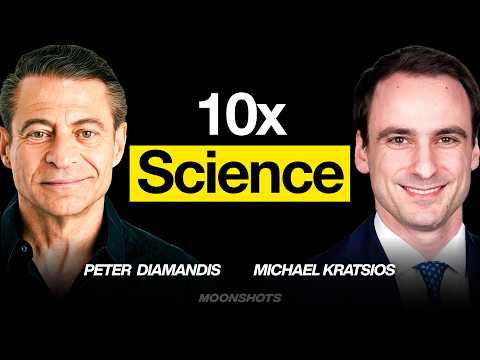
How the White House Plans to 10x Scientific Productivity | Michael Kratsios | EP #276
Peter DiamandisMichael Kratsios
Michael Kratsios frames regulation as a market catalyst for technologies “born in captivity,” while national missions aim to create demand across AI, chips, robotics, quantum computing, and space.The Golden Age blueprint targets 10x scientific productivity through five-year grants, autonomous laboratories, public datasets, and AI-native research markets, with export financing and semiconductor controls shaping competition; execution and public acceptance remain key risks.
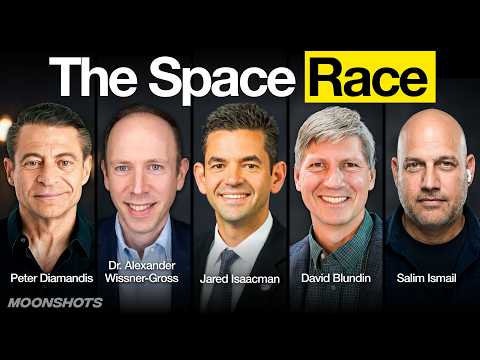
Jared Isaacman: NASA's Moon Base by 2028, Optimus Robots on the Moon, and 15 Years to Mars | Ep #274
Peter DiamandisSalim IsmailDave BlundinAlexander Wissner-GrossJared Isaacman
Jared Isaacman’s NASA reset centers on modular programs, reusable transport and a few near-impossible objectives, arguing that $25 billion annually can fund more progress through sharper capital allocation.A 2028 lunar landing would begin with frequent low-cost robotic failures and learning, while nuclear propulsion, autonomous science and commercial orbital data centers could determine the timeline toward returnable Mars missions.
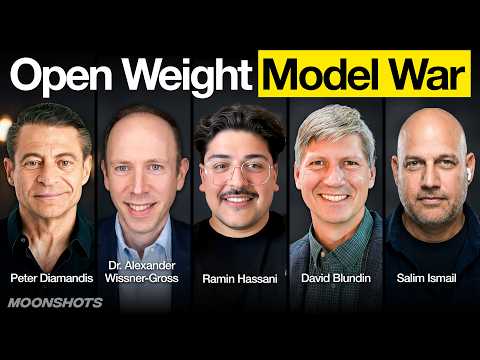
Mira Murati's 975B Open Model, Ramin Hasani on Post-Transformer AI, and Demis' AI FINRA | EP #271
Peter DiamandisSalim IsmailDave BlundinAlexander Wissner-GrossRamin Hasani
Frontier AI governance is becoming a contested market structure: Demis Hassabis’s industry-funded, FINRA-style watchdog could improve pre-release testing, while critics warn of regulatory capture and exclusion of open-weight competitors.Thinking Machines Lab’s 975B-parameter Inkling bets on on-prem customization, activating 41B parameters with a 1M-token context window.Liquid AI’s sub-1GB Mercedes deployment and AI²’s self-reported, independently unconfirmed claims leave deployment economics, governance, and genuine recursive capability as key watchpoints.

Sonnet 5 Drops, China’s $4,900 Robot, Fusion’s First Plant Gets Licensed W/ Philip Johnston | #268
Peter DiamandisSalim IsmailDave BlundinDr. Alexander Wissner-GrossPhilip Johnston
Fable 5’s 15-day shutdown over national-security concerns made frontier-model access a regulatory and supply-chain risk, while Sonnet 5 monetizes scarcity.Unitree’s $4,900 R1 and China’s 500,000-unit 2030 forecast point toward commodity bodies, shifting value to software, workflows and manufacturing scale.Helion’s approved Orion plant targets 50 MW for Microsoft in 2028, while StarCloud’s orbital GPU tests make launch the constraint.
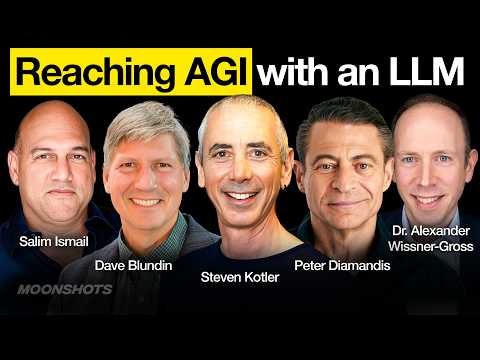
Demis Hassabis on AGI, Robots Scale Production, and Elon’s $1T Mars-Shot Comp | EP 253
Peter DiamandisSteven KotlerSalim IsmailDave BlundinDr. Alexander Wissner-Gross
SpaceX’s compensation proposal makes founder control an all-or-nothing contract: 200 million 10-to-1 super-voting shares require a million-person Mars colony and a $7.5 trillion valuation.Figure targets 100,000 robots by 2030 and 1X 100,000 in 2027, moving humanoids toward factory scale while leaving the winning form factor unresolved.GLP-1 manufacturing, not demand, is the binding constraint; retatrutide approval is projected for mid-2027.
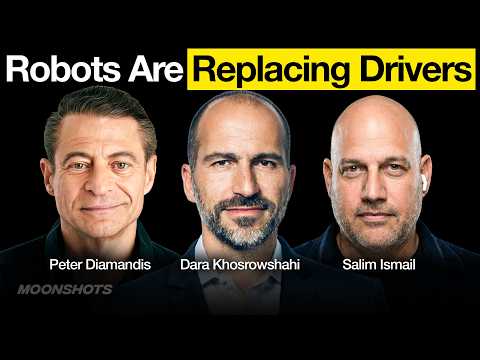
Uber’s Robotaxi Playbook, End of Human Driving & $10B Bet on Robots | Dara Khosrowshahi (Uber CEO)
Dara KhosrowshahiPeter Diamandis
AV demand is arriving before mass production at regular-car prices: in Atlanta and Austin, 80% of riders accept an autonomous match and 20% decline.Dara Khosrowshahi told a 13-year-old that, three years from now, they would still likely want a license because AVs remain “much more expensive than a regular car,” but says that 10…
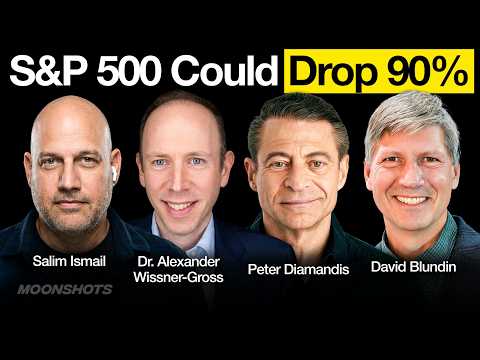
Elon Enters the Chip Race, the S&P 500 Repricing, and Human Drivers Will Become Illegal | EP #242
Peter DiamandisSalim IsmailDave BlundinAlexander Wissner-Gross
Musk’s Terafab targets 1 terawatt of annual AI-compute capacity versus roughly 20 gigawatts today, making compute the proposed organizing resource of the economy.Demand may absorb every process node as autonomy, AI labor compression, and model distillation expand usage, but ASML, materials, power, labor, capital, and Musk’s timing remain critical execution risks.