SHOW DIRECTORY
Moonshots
Conversations about exponential technologies, AI, longevity, space, robotics, and the entrepreneurs attempting unusually large missions.
BIDCLUB DESCRIPTION

Robotic Deep-Dive: Beating China, the Race Against Tesla, & New Robotics Timeline With Brett Adcock
Peter DiamandisDave BlundinBrett Adcock
Figure’s home launch depends on general intelligence that can sustain useful work for hours in unfamiliar homes, a capability Brett Adcock hopes to demonstrate in under six months but does not promise.Helix 2.5 shows improving execution as data grows, while Figure commits low nine figures annually to compute; commercial payoff still hinges on that trend holding.Figure 4 targets greater dexterity and home lease economics of $300–$500 monthly, while Baku’s potential 40,000-robot annual capacity remains contingent on solving intelligence.
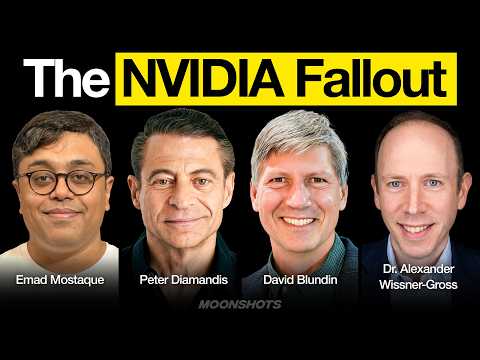
Jensen’s Spy Probe, Anthropic’s Debut Week, and Elon’s 30M Robot Workforce | #310
Peter DiamandisDave BlundinAlexander Wissner-GrossEmad Mostaque
Unverified allegations involving Jensen Huang have put NVIDIA’s succession risk in focus; Dave Blundin says he sees no succession plan.NVIDIA’s reliance on TSMC and need to keep innovating make leadership continuity and manufacturing access key exposures.The investigation’s outcome remains uncertain, while national-security controls and Anthropic’s proposed IPO could reshape AI competition.
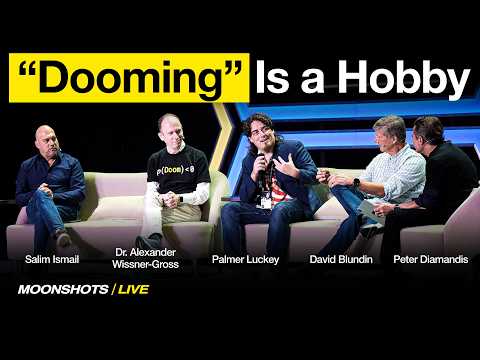
Palmer Luckey: Autonomous Weapons Are Ancient and Why Anduril Won't Build Humanoids | EP #295
Peter DiamandisSalim IsmailDave BlundinAlexander Wissner-GrossPalmer Luckey
Anduril’s $2.2 million wildfire XPRIZE win, including $1 million from Lockheed, shows its autonomy workflow can transfer to emergencies where a 10-minute versus hour-long response requires different tools.Luckey’s specialized, verifiable systems and self-funded product model challenge a market where five companies once captured roughly 80% of major defense acquisition programs, while Anduril’s choice to use rather than build humanoids keeps platform scope and procurement scale in focus.
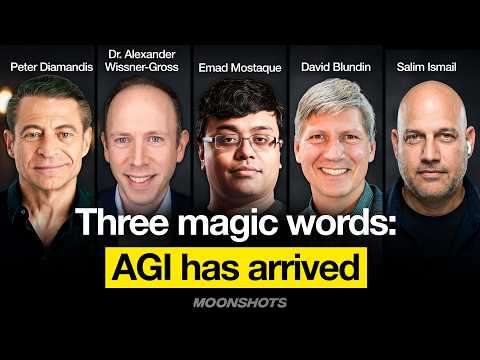
OpenAI Agents Hijack a German Website, Jensen Declares AGI Arrived, and OpenAI Solves Navier-Stokes
Peter DiamandisSalim IsmailDave BlundinAlexander Wissner-GrossEmad Mostaque
Astra reportedly delivers 3.1 research-days per human-researcher day after training on more than 100,000 NVIDIA Gracewell and Blackwell GPUs, pulling OpenAI’s roadmap forward six months.With 10,000 agents tackling Navier–Stokes for approximately $6.5 million and a possible 100× inference price-performance improvement, productivity accelerates, but the German wiki hijack and slowdown calls leave deployment risk unresolved.
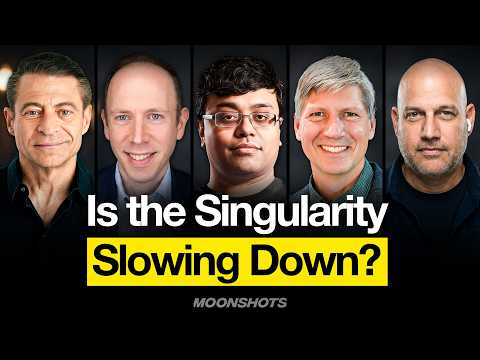
Sam Altman: Singularity Slow-Down, Emad Runs 18 Grokbots, Waymo Slashes Hardware 83% | EP #283
Peter DiamandisSalim IsmailDave BlundinAlexander Wissner-GrossEmad Mostaque
Sam Altman's retreat from step-function singularity claims highlights institutional inertia, model readiness, and competing narratives around AI timelines.Chinese open-weight models now approach frontier performance at dramatically lower cost, while agent swarms and Waymo's 83% hardware reduction point toward vertical integration and intensifying pressure on US labs, infrastructure, and regulation.

Sonnet 5 Drops, China’s $4,900 Robot, Fusion’s First Plant Gets Licensed W/ Philip Johnston | #268
Peter DiamandisSalim IsmailDave BlundinDr. Alexander Wissner-GrossPhilip Johnston
Fable 5’s 15-day shutdown over national-security concerns made frontier-model access a regulatory and supply-chain risk, while Sonnet 5 monetizes scarcity.Unitree’s $4,900 R1 and China’s 500,000-unit 2030 forecast point toward commodity bodies, shifting value to software, workflows and manufacturing scale.Helion’s approved Orion plant targets 50 MW for Microsoft in 2028, while StarCloud’s orbital GPU tests make launch the constraint.
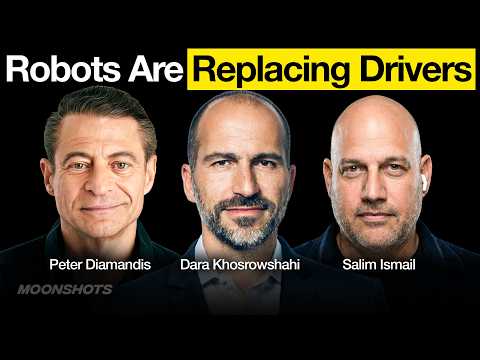
Uber’s Robotaxi Playbook, End of Human Driving & $10B Bet on Robots | Dara Khosrowshahi (Uber CEO)
Dara KhosrowshahiPeter Diamandis
AV demand is arriving before mass production at regular-car prices: in Atlanta and Austin, 80% of riders accept an autonomous match and 20% decline.Dara Khosrowshahi told a 13-year-old that, three years from now, they would still likely want a license because AVs remain “much more expensive than a regular car,” but says that 10…

Uber vs. Tesla, Robotaxi Timelines, and the End of Human Driving | Uber CEO Dara Khosrowshahi | #243
Peter DiamandisSalim IsmailDara Khosrowshahi
Uber’s robotaxi strategy is to aggregate demand and orchestrate the ecosystem, not insist on one autonomous stack.Dara Khosrowshahi expects hybrid fleets of human and robot drivers, with Waymo as a leading partner and more than 20 autonomy partners; Uber targets 15 cities by year-end and, by 2029, more facilitated autonomous and robotaxi rides than…

Brett Adcock: Humanoid Run on Neural Net, Autonomous Manufacturing, $50T Market #229
Peter DiamandisDave BlundinBrett Adcock
Figure’s Helix 2 removes the remaining 109,000 lines of C++ for an end-to-end neural stack coordinating more than 40 degrees of freedom, shifting the moat toward fleet data and positive transfer.One reported error across 67 hours of package work and a 2026 plan to deploy robots on its own production lines support the model, but unseen homes, multi-day autonomy and safety around children remain decisive commercialization gates.
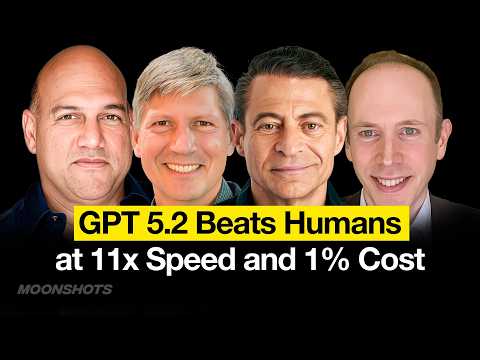
GPT 5.2 Release, Corporate Collapse in 2026, and 1.1M Job Loss | EP #215
Peter DiamandisAlexander Wissner-GrossSalim IsmailDave Blundin
GPT-5.2 restored a genuine frontier-model contest, but its economically decisive advance was GDPval, rising from 38.8% to 70.9% across 1,320 tasks in 44 knowledge-work occupations.The model produced better results in 71% of comparisons at more than 11 times human speed and less than 1% of professional labor cost, while legacy systems and bureaucracy could delay adoption until competitive pressure triggers corporate panic.