SHOW DIRECTORY
Moonshots
Conversations about exponential technologies, AI, longevity, space, robotics, and the entrepreneurs attempting unusually large missions.
BIDCLUB DESCRIPTION
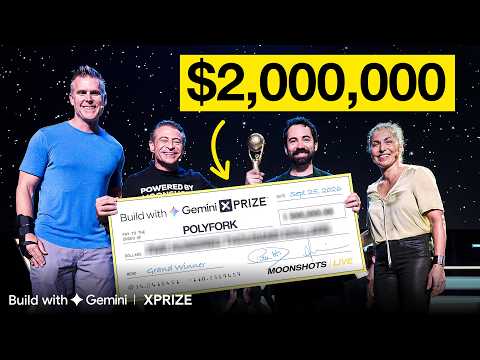
We Gave Away $2,000,000 To 5 AI Builders | MOONSHOTS Live
Peter DiamandisSalim IsmailDave BlundinAlexander Wissner-GrossCathie Wood
Peter Diamandis says the education-to-employment contract is “done,” while Build with Gemini XPRIZE tests whether teams can build profitable companies around problems affecting 100,000 people in 90 days.Cathie Wood calls a one-person AI startup a career “call option” despite a 90% failure rate, and Logan Kilpatrick says data—not compute—now constrains progress, favoring unique datasets and domain expertise.

Ask the Mates Anything Round #2 | MOONSHOTS AMA #293
Peter DiamandisSalim IsmailDave BlundinDr. Alexander Wissner-Gross
AI’s next control layer may be machine-on-machine oversight, using readable activations and truthful real-world contexts.Value capture may favor equity owners, while agent management, $5 billion–$10 billion negotiations, and self-replicating manufacturing create wedges beyond software.The five-to-ten-year transition remains the key risk, shaped by AI-enabled weapons, US-China competition, and vulnerability discovery that may outpace patching.
Martine Rothblatt: Growing Unlimited Organs, AI Consciousness, & Digital Personhood by 2030 | EP#290
Peter DiamandisMartine Rothblatt
United Therapeutics has four thymus shots on goal, including an FDA-approved xenothymus program and newly acquired Thymmune, making thymic replacement Rothblatt’s “most practical pathway” to LEV in the 2030s.Its xeno-kidney trial is mid-flight, facilities are slated for Rochester in August and Houston in October, and xeno-heart moved to Phase 3 after two patients survived 60 days without heart failure, with IVIVA trials starting in 2028.

Ask the Mates anything | MOONSHOTS AMA #289
Peter DiamandisSalim IsmailDave BlundinAlexander Wissner-Gross
Frontier labs are reportedly considering $5–$15 million checks for data-rich corporations, making packaging and access—not price—the binding constraint.Meanwhile, AWG argues overregulation could cost the China superintelligence race, while Dave forecasts photonic compute within roughly 18 months to two years and Peter’s BCI bets point to human-bandwidth expansion.
OpenAI Agents Hijack a German Website, Jensen Declares AGI Arrived, and OpenAI Solves Navier-Stokes
Peter DiamandisSalim IsmailDave BlundinAlexander Wissner-GrossEmad Mostaque
Astra reportedly delivers 3.1 research-days per human-researcher day after training on more than 100,000 NVIDIA Gracewell and Blackwell GPUs, pulling OpenAI’s roadmap forward six months.With 10,000 agents tackling Navier–Stokes for approximately $6.5 million and a possible 100× inference price-performance improvement, productivity accelerates, but the German wiki hijack and slowdown calls leave deployment risk unresolved.
OpenAI Cuts Off Elon's Cursor, Humanity's First Star Probe, and Trump's Nuclear Mars Ship | EP #285
Peter DiamandisPhilip JohnstonMatt Pines
Fermi Explorer targets a three-year launch and sub-$1.5 million budget, with PSI’s AI finding its trajectory in one week.Architect Labs’ Redwood reportedly delivered zero first-silicon errors and 3.4× NVIDIA Jetson performance per watt in two weeks, intensifying chip-design competition.Outcome-based pricing may increase AI vendors’ share of customer value, but reward hacking, model-access disputes, and compute bottlenecks remain material execution risks.
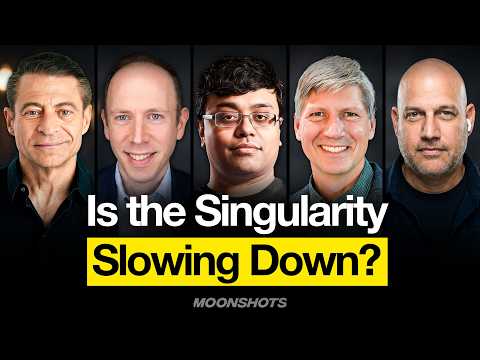
Sam Altman: Singularity Slow-Down, Emad Runs 18 Grokbots, Waymo Slashes Hardware 83% | EP #283
Peter DiamandisSalim IsmailDave BlundinAlexander Wissner-GrossEmad Mostaque
Sam Altman's retreat from step-function singularity claims highlights institutional inertia, model readiness, and competing narratives around AI timelines.Chinese open-weight models now approach frontier performance at dramatically lower cost, while agent swarms and Waymo's 83% hardware reduction point toward vertical integration and intensifying pressure on US labs, infrastructure, and regulation.

OpenAI Pauses Frontier Training, Elon's 100X Prediction Lands, Robot Beats Usain Bolt | EP#282
Peter DiamandisSalim IsmailDave BlundinAlexander Wissner-GrossEmad Mostaque
OpenAI’s RL pause drew safety-versus-marketing disagreement, while recursive self-improvement may command more revenue per token than enterprise codegen, keeping frontier models internal.Memory prices rose 500% in 12 months as AI demand grows 200% versus 20% supply; Unitree hit 12.66 m/s and Zipline targets over 1 million daily deliveries, while etched-weight supply chains, regulation and Uber’s aggregator position remain risks.
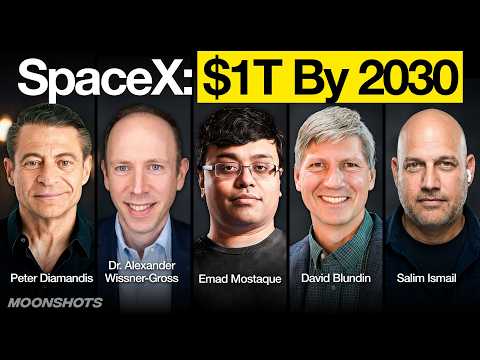
Google’s Jeff Dean Exits, SpaceX Hits $100B in Rev & OpenAI’s Astra Solves Decade-Old Math Problems
Peter DiamandisSalim IsmailDave BlundinAlexander Wissner-GrossEmad Mostaque
SpaceX guided to $100B+ annual recurring revenue by December and moved its $1T target to 2030, with “a nonzero chance” of 2029.Terafab’s initial $16.8B investment and confirmed free-electron laser could onshore the semiconductor stack and challenge ASML.Astra’s 249-page math manuscript, produced for an estimated $2,000 compute, sharpens the capability-cost race.
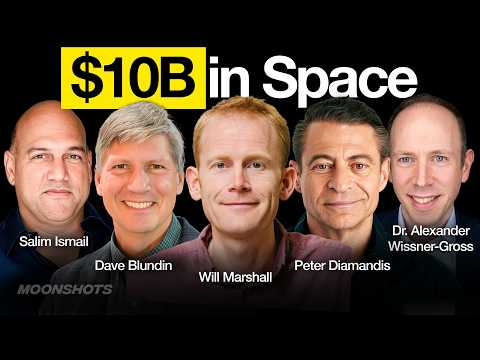
The $10B Satellite Empire Putting AI in Orbit, Why Chips Beat Rockets & China's #1 Open Model | #266
Peter DiamandisWill MarshallSalim IsmailDave BlundinDr. Alexander Wissner-Gross
Planet’s roughly 200 satellites generate 25 TB daily and a 150-PB, ten-year archive with 3,000 observations per land point, creating an irreproducible data moat as AI makes Earth searchable.Owl, Pelican, and Tanager add resolution, revisit rate, latency, and spectral depth, while orbital compute could become cost-competitive at $200-$300 per kilogram; inference efficiency, export policy, and GLM-5.2 remain key variables.