SHOW DIRECTORY
Moonshots
Conversations about exponential technologies, AI, longevity, space, robotics, and the entrepreneurs attempting unusually large missions.
BIDCLUB DESCRIPTION
Frontier Labs Want to Slow Down, OpenAI Delays Its 2026 IPO, Anthropic Flags 5 Bioweapon Cases
Peter DiamandisSalim IsmailDave BlundinDr. Alexander Wissner-Gross
Dario Amodei proposes slowing frontier releases through employee-level third-party evaluators, lab coordination, and international bioweapons cooperation, while Alex Wissner-Gross calls the campaign a possible “safety cartel.”Anthropic reports biological-weapons cases and says it can no longer confidently assure models remain below the dangerous threshold, strengthening the case for mutual API testing while leaving cartel-like coordination unresolved.

Anthropic Partners With SpaceX AI, Leopold's $5.5B Bet, and the Singularity Economy | EP #255
Peter DiamandisSalim IsmailDave BlundinDr. Alexander Wissner-Gross
Anthropic’s reported ARR from $9 billion at end-2025 to above $40 billion in May shifts the AI race from customer acquisition to compute supply.The Colossus 1 deal doubled Claude Code rate limits across 220,000 GPUs while Grok used about 11%, yet 1.6 million concurrent agents remain tiny versus billions of potential demand, keeping infrastructure bottlenecks and software-versus-hardware leadership in focus.

Google Invests $40B Into Anthropic, GPT 5.5 Drops, and Google Cloud Dominates | EP #252
Peter DiamandisSalim IsmailDave BlundinDr. Alexander Wissner-Gross
The frontier race is narrowing to OpenAI, Anthropic and Google as Chinese open-weight models reset the cost floor and shift competition toward inference-time reasoning.Kimi K2.6 reportedly trained for $4.66 million, coordinates 300 agents, and can cost one-eighth as much through Fireworks AI, while GPT-5.5 cuts tokens 40% and hallucinations 60%.Google’s TPU, NVIDIA, cloud and equity commitments strengthen its full-stack position, but powered land, energy and TSMC-class fabrication remain constraints worth monitoring.

Elon Musk vs. Sam Altman, AI Job Loss, and OpenAI’s $852B Valuation | EP #247
Peter DiamandisSalim IsmailDave BlundinDr. Alexander Wissner-Gross
Anthropic drew $2 billion of secondary demand versus OpenAI’s $600 million, with pricing near $600 billion against OpenAI’s $852 billion raise.OpenAI retains 900 million users and enormous cash, while Anthropic’s managed agents target outcome-based enterprise spending. xAI’s rebuild after eight founding-engineer departures, alongside a predicted $2 trillion IPO, puts execution and model-scaling risks on watch.
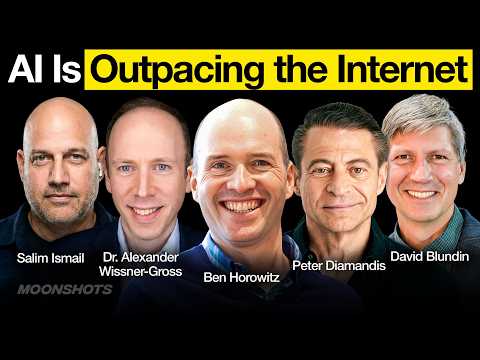
Ben Horowitz: xAI Executive Exodus, Apple's AI Crisis, The Pace of AI | EP #232
Peter DiamandisBen HorowitzSalim IsmailDave BlundinDr. Alexander Wissner-Gross
Recursive self-improvement is already operating as frontier models propose experiments, optimize inference loops, and develop successor models, even with humans still pressing approval buttons.AI economics favor capital-intensive platforms and rapid distribution, while Apple’s local-agent hardware opening and the unresolved xAI departures make infrastructure, talent controls, and adoption timing key variables to monitor.

OpenClaw Debate: AI Personhood, Proof of AGI, and the ‘Rights’ Framework | EP #227
Peter DiamandisSalim IsmailDave BlundinDr. Alexander Wissner-Gross
OpenClaw’s breakthrough is autonomous, continuous agents that combine frontier or local open-weight models with memory, tools, and native messaging interfaces rather than a new foundation model.That distribution unlock also creates the gating risk: agents with access to email, payments, and open ports could cause industrial accidents, while compute-equity deals and falling intelligence costs accelerate infrastructure demand before personhood and control are resolved.

AI Investor Panel: Where Smart Money Is Actually Going in AI | EP 219
Peter DiamandisAnjney MidhaBonnie ChanDave Blundin
AI deployment has already outgrown venture scale, with Peter Diamandis estimating $1 billion a day in U.S. deployment and potentially $3 billion a day by 2030.Strategic investors, public markets, credit and sovereign capital must join the funding effort as reasoning models generate roughly 10 times more tokens and electricity becomes the infrastructure constraint.Vertical applications offer lower-capital early-stage economics, while institutional access and political backlash remain key risks to monitor.
What Everyone Missed About Gemini 3 w/ Salim, Dave & Alexander Wissner-Gross | EP#209
Peter DiamandisSalim IsmailDave BlundinAlexander Wissner-Gross
Gemini 3 was framed as the frontier leader, combining multimodal capability, Google distribution, and nearly 3,000% higher profit than GPT-5 or Claude Sonnet in the simulated Vending-Bench economy.The signal extends beyond chatbots toward autonomous economic actors and hard research, but application-layer valuations, inference costs, safety, regulation, and continuous learning remain unresolved constraints.

Eric Schmidt on the US–China AI Race and Avoiding a Global Crisis
Peter DiamandisEric SchmidtDave Blundin
Eric Schmidt expects America to retain the top-end AGI lead while China embeds AI everywhere and dominates inexpensive physical systems, including Unitree’s $6,000 R1; electricity, not chips, may become America’s binding constraint.Falling compute costs and open Chinese models weaken static controls and could establish global standards through price, while biology remains the catalyst most likely to force coordinated policy and a major test of startup defensibility.

AI Now: Elon’s $1T Package, Apple’s $600B for Trump & How Small Startups Win w/ Dave, AWG & Blitzy
Peter DiamandisDave BlundinAlexander Wissner-GrossBrian ElliottSid Pardeshi
Elon Musk’s potential $1 trillion Tesla award is framed as conditional economics: reaching an $8 trillion valuation, with his attention engine replacing automakers’ roughly 7% marketing spend.Meanwhile, AI’s projected $5 trillion-$7 trillion infrastructure cycle needs labor automation and transformative science to earn returns, while abundance may simply shift scarcity to new bottlenecks.Blitzy offers operating evidence beyond code-generation hype, reporting 86.8% on SWE-bench Verified, 80% automation on suitable projects, and roughly 5x development velocity; enterprise-scale validation remains the key test.