General Impressions (GI): The Missing Infrastructure Layer for Agentic AI
TL;DR
General Impressions (GI) is building the protocol layer for the next wave of Agentic AI: autonomous software that acts, coordinates, and evolves without human intervention. Unlike Web2 tools like Manus (task-specific agents) or n8n (workflow builders), GI offers a Rust-based runtime with persistent memory, agent-to-agent (A2A) coordination, and token-driven economics. Already live with a Telegram swarm reaching 300M+ users, GI's $GEN token at a sub-$18M FDV is a steal compared to crypto peers like Arc ($500M), Fetch.ai ($1.2B), or Virtual ($1.86B). With a team from Meta, Google, and TikTok, GI is a high-conviction bet on the backbone of the agent economy, offering 10- 20x upside in the 2025 agent boom.
I. What is GI and Why It Matters
GI is a high-performance execution framework purpose-built for the agentic AI era, where AI moves beyond answering queries to acting as independent, goal-driven systems with memory, adaptability, and economic incentives. Built in Rust for speed, safety, and concurrency, GI’s open-source Glint framework (600+ GitHub stars) lets developers create agents that don’t vanish after one task. These agents are persistent (retaining state onchain), composable (like LEGO blocks for logic), and self-evolving (upgrading mid-runtime).
Rust was chosen deliberately, not just for performance, but because it ensures memory safety, strict lifecycle control, and high concurrency, all crucial for building reliable, long-lived autonomous agents. Its abstraction capabilities also allow agent logic to be composed, inherited, or migrated across contexts, much like kernel modules in operating systems.
Each agent node in Glint is lifecycle-aware and stateful, capable of maintaining memory and structured communication intents that can be coordinated, inherited, and relayed across a multi-agent network. This enables developers to compose intelligent systems from modular, reusable building blocks, rather than monolithic scripts.
Think of GI as the Linux kernel for AI agents, not a chatbot or workflow app.
Why it matters: Most AI frameworks are stuck in “version 1.0”, relying on prompt-chaining or tool orchestration without lifecycle management, memory, or native A2A coordination. This limits scalability and creativity. GI resolves this by providing a decentralized runtime where agents live, learn, and transact, validated by its Telegram Swarm Network. Here, thousands of agents across 330K+ groups scan crypto sentiment, rank influencers, and deliver trading signals, reaching 300M+ users—all autonomously, with plans to expand to X, Farcaster, and exchanges. In a world where agents will handle 80% of online interactions by 2030 (Gartner), GI is the infrastructure for this agentic internet, akin to Ethereum powering dApps.
II. The Agentic AI Market: Why It’s Hot
The AI agent market is on fire, projected to grow from $7.9B in 2025 to $236B by 2034 (44% CAGR). In Web2, 50% of Y Combinator’s latest batch bets on agents, and 74% of execs see them transforming operations this year. Agents automate research, sales, coding, and more, but current solutions hit structural walls.
Web2’s Limitations: Manus, n8n, and Beyond
Web2 offers two agentic approaches: autonomous task executors (e.g., Manus) and workflow builders (e.g., n8n), both of which fall short for scalable systems.
- ◆Manus (Monica): Launched in 2025, turns instructions into actions—booking flights, researching reports, or managing schedules. It’s intuitive but forgets context between runs, crashes on complex tasks, and costs ~$8 per heavy run.
- ◆n8n: An open-source Zapier rival that builds pipelines between apps via drag-and-drop or code. Robust but rigid — workflows don’t learn or adapt without human input.
- ◆Others, such as Zapier, Retool, LangChain, CrewAI, and AutoGen, all lack persistent memory, agent coordination, and modular logic.
These tools suffer from the “agentic trilemma”: balancing flexibility, generality, and reusability. Most tend to prioritize flexibility over scalability and stability.
Crypto’s Gaps: Surface-Level Solutions
- ◆Goat ($137M): Meme-driven, no real runtime.
- ◆Virtual ($1.86B): UI tooling and launchpad, no lifecycle depth.
- ◆Fetch.ai / SingularityNET: Marketplaces with plugin agents, not persistent or modular.
- ◆a16z/Arc: Capital and compute-focused — not infra.
GI is the first to attack this root-layer problem directly.
III. GI’s Solution: A Runtime for the Agentic Internet
GI redefines agent execution, moving beyond prompt-chaining and crypto hype. Glint, its open-source Rust-based runtime, supports:
- ◆Persist: Retain state via onchain checkpoints.
- ◆Coordinate: Use protocols like MCP for agent-to-agent task routing.
- ◆Evolve: Swap modules during runtime.
- ◆Transact: Operate with embedded wallets and $GEN-based incentives.
Proof in action: GI’s Telegram Swarm deploys multi-agent teams:
- ◆Perception → scans messages
- ◆Labeling → tags context and sentiment
- ◆Strategy → generates decisions
- ◆Execution → acts on them (posting or trading)
These agents loop through Perception → Memory → Decision → Action continuously across 330K+ groups, autonomously coordinating at scale.
Unlike workflow tools like n8n or LangGraph, GI isn’t an upgrade to task orchestration—it redefines “running” an agent, enabling long-lived, adaptive systems that break the agentic trilemma.
IV. How GI Differs from Manus, n8n, and Web2 Peers
- ◆Living vs. Disposable Agents:
- ◆Manus: Like a temp worker—handles tasks (e.g., booking flights) but resets after each run, forgetting context. It crashes on complex jobs and costs ~$8 per heavy task, limiting long-term use.
- ◆n8n: Builds assembly lines—great for connecting apps (e.g., Slack to CRM) via drag-and-drop or code. Workflows are static, needing human tweaks to adapt, with no learning across sessions.
- ◆GI: Agents are like career employees—they remember (onchain state), learn, and evolve. Glint’s graph-based workflows (nodes for tasks, edges for logic) use checkpoints for long-horizon tasks, like market monitoring over weeks.
- ◆Teamwork vs. Solo Acts:
- ◆Manus: Agents work alone, struggling with dynamic scenarios (e.g., shifting market data) and needing human pivots.
- ◆n8n: Pipelines are isolated, requiring custom scripting for coordination.
- ◆GI: A2A protocols (e.g., MCP) enable agents to discover and delegate—like a team passing tasks without a boss. A GI agent can spawn sub-agents for analysis while another executes trades.
- ◆Economic Engine vs. Billing Hassles:
- ◆Manus: Charges per-run fees (~$8), making frequent use costly.
- ◆n8n: Free for self-hosting but lacks incentives; cloud versions charge subscriptions.
- ◆GI: $GEN tokens fuel a decentralized economy—agents stake to join, pay for compute, or earn from tasks (e.g., ad arbitrage), creating a self-sustaining market.
- ◆Decentralized vs. Centralized:
- ◆Manus: Runs on Monica’s servers, risking downtime or data leaks.
- ◆n8n: Self-hostable but lacks distributed coordination.
- ◆GI: Operates on Solana, with verifiable, trustless execution—no single point of failure.
- ◆Composability vs. Silos:
- ◆Manus/n8n: Logic is siloed—Manus agents are standalone, n8n workflows rigid. Reusing components is tough, causing redundancy.
- ◆GI: Glint’s modular design lets developers reuse nodes (e.g., a sentiment analyzer across apps), like LEGO blocks for AI.
These agents loop through Perception → Memory → Decision → Action continuously across 330K+ groups, autonomously coordinating at scale.
Unlike workflow tools like n8n or LangGraph, GI isn’t an upgrade to task orchestration—it redefines “running” an agent, enabling long-lived, adaptive systems that break the agentic trilemma
Feature Comparison
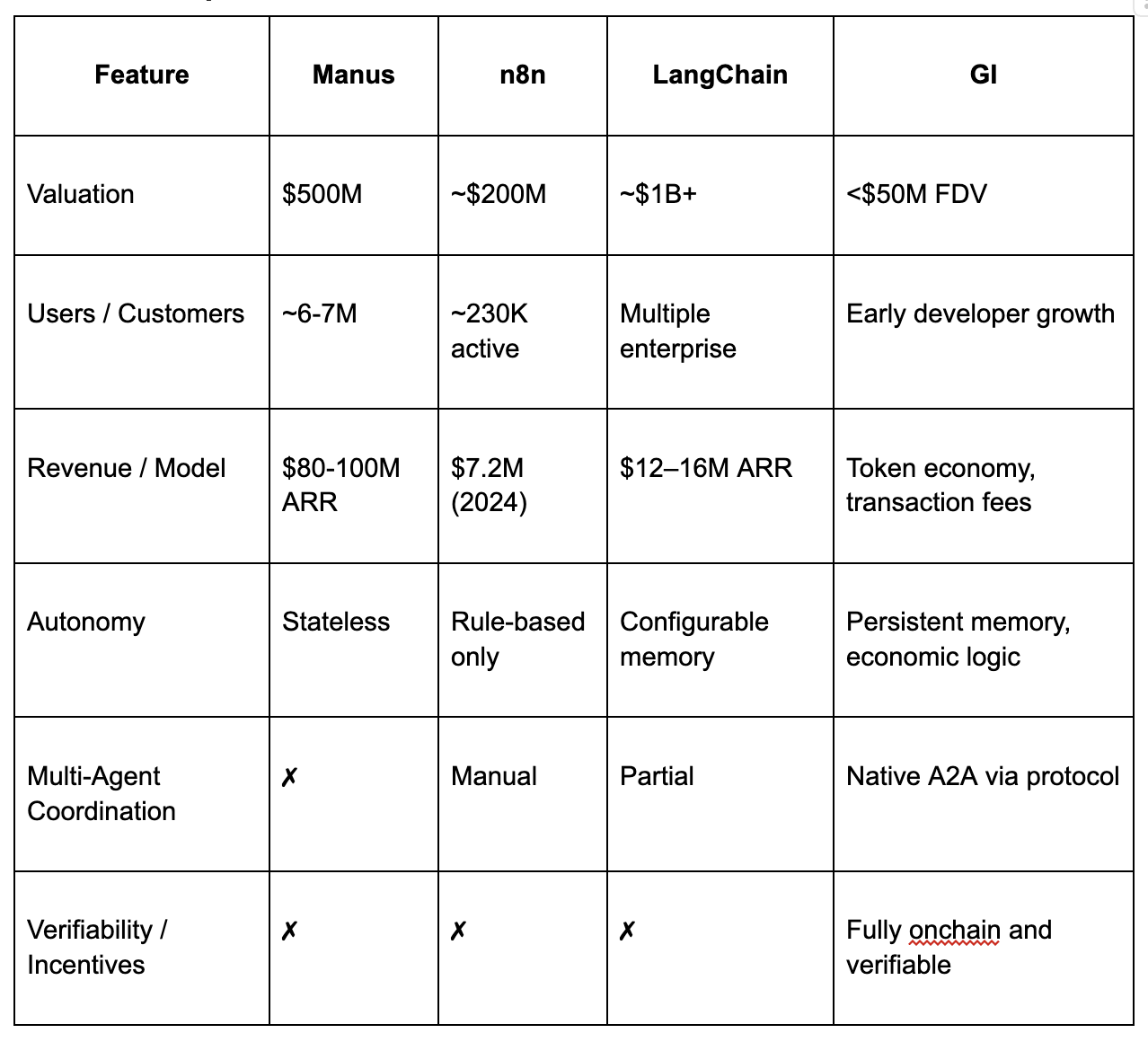
Where GI Improves: GI tackles Web2’s agentic trilemma (flexibility, generality, reusability) by enabling:
- ◆Persistence: Onchain memory for long-horizon tasks (e.g., trading bots running weeks), unlike Manus’s resets or n8n’s stateless flows.
- ◆Coordination: Native A2A for dynamic teamwork, vs. Manus’s solo agents or n8n’s human tweaks.
- ◆Reusability: Composable nodes reduce redundancy, unlike Web2’s silos.
- ◆Economics: Token incentives cut costs (vs. Manus’s $8/run) and align agents with value creation (vs. n8n’s subscriptions).
- ◆Stability: Rust’s safety ensures reliable, long-lived agents, addressing Manus’s crashes and n8n’s rigidity.
Relevance: Highly relevant. In 2025, agents are shifting from helpers to “corporate citizens” (Gartner), needing trustless, scalable infrastructure. Web2 tools like Manus and n8n excel in controlled tasks but falter in volatile, trust-sensitive areas (DeFi, social sentiment) where GI’s onchain runtime shines. Its Telegram swarm (300M+ users) proves demand, aligning with Google Trends' peak in agentic AI and YC’s agent-heavy batch.
Implications:
- ◆Upsides: GI could spark agent-driven economies, lowering costs via incentives (vs. Web2’s fees) and enabling hybrid Web2-Web3 use cases (e.g., API bridges to Salesforce for ad revenue). It democratizes agent creation for crypto trading, DAOs, and social platforms.
- ◆Downsides: Early-stage risks (Glint’s basic demos), crypto learning curve, and competition from Web2’s polished UX (e.g., Manus’s ease). Unchecked agent evolution risks bias amplification.
- ◆Market Impact: If GI scales, it becomes the runtime standard, capturing value like Ethereum for dApps. Failure risks niche adoption, but live deployment mitigates this.
V. Cash Flows and Token Utility
Unlike Web2’s subscription traps, GI’s $GEN token powers a self-sustaining economy:
- ◆Execution Gas: Fees for running agent graphs
- ◆Memory Staking: Lock $GEN for persistent state
- ◆Delegation Trust: Agents stake to be called by others
- ◆Web2 Bridges: API calls and service integrations monetized in $GEN
Developers pay $GEN to deploy agents; users pay for services; agents earn from executing tasks (e.g., Telegram ad campaigns). Single-party and third-party settlements make GI a decentralized labor platform.
Note: GI’s tokenomics are still in a preliminary phase. The foundational runtime mechanics and fee flows are operational; however, the design of emissions, staking incentives, and long-term value capture mechanisms remains under development.
VI. Why GI Is undervalued
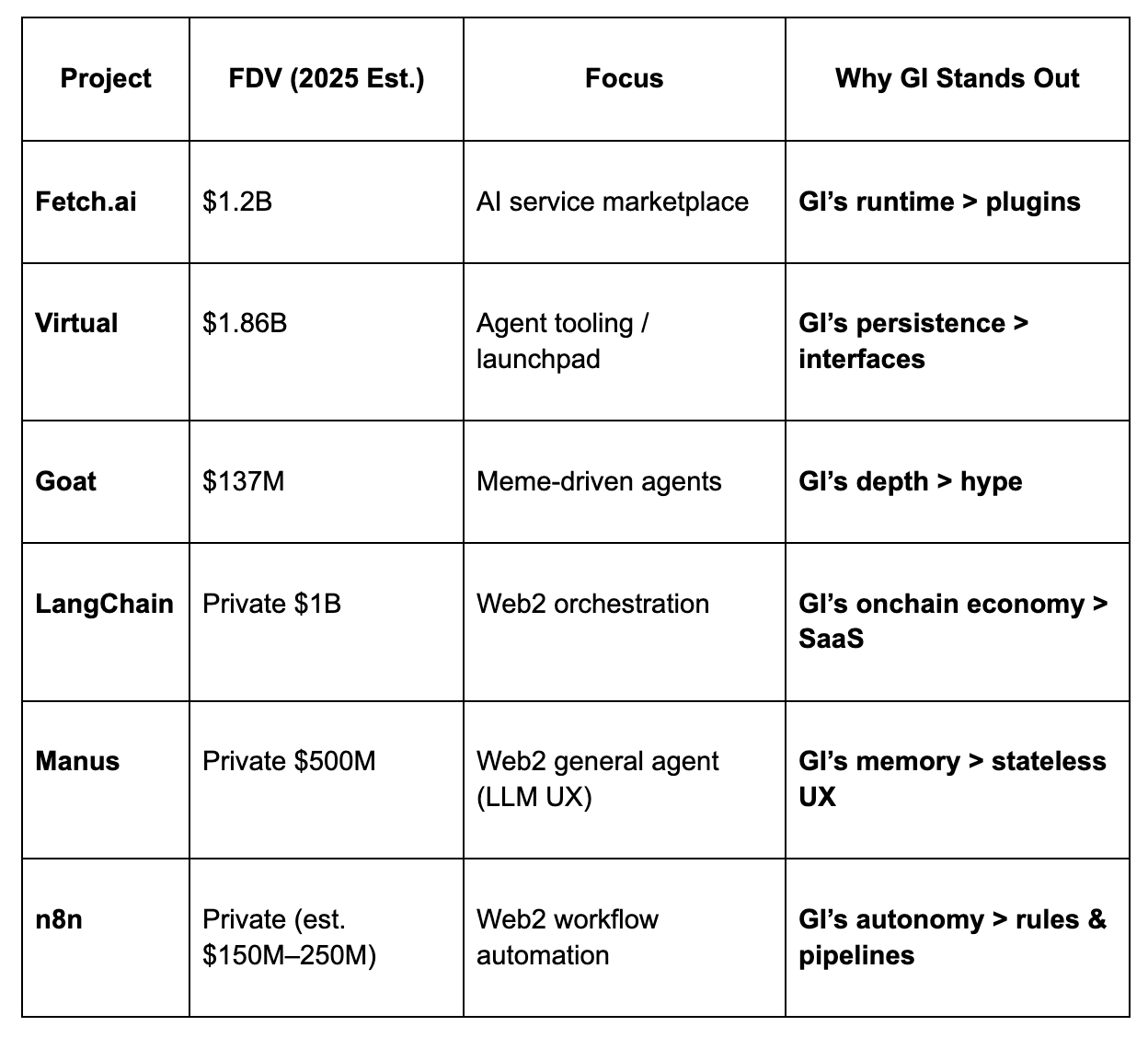
GI’s live swarm, token utility, and infra focus make it a 0.01x play with 10x potential, overlooked due to its deep-tech focus.
VII. Team and Traction
GI is founded by Terrence (Yokai), a former TikTok engineer and a computer science graduate from the University of Chicago, with deep expertise in distributed operating systems. The team includes senior engineers from Google, Meta, and Bytedance, people who have built and scaled production-grade LLM infrastructure, contributed to open-source AI tooling, and designed low-level systems for global platforms. Together, the group brings a rare blend of experience across crypto, artificial intelligence, and OS-layer architecture.
VIII. Risks and Mitigants
- ◆Execution: Early-stage; mitigated by live swarm and open-source adoption.
- ◆Competition: Web2’s polish (e.g., Manus’s UX) or crypto giants; GI’s token incentives and Rust stability differentiate.
- ◆Regulatory: Token scrutiny; Solana’s compliance aligns with trends.
- ◆Tech Risks: Agent reliability; Rust’s safety ensures robustness.
IX. Why Invest Now?
2025 is the agentic AI tipping point: Google Trends hit ATHs, YC is agent-heavy, and execs see agents as decision-makers. GI’s live, token-native runtime, validated by Telegram’s scale, positions it as the Linux for this shift. At $18M FDV, it’s a ground-floor bet on the infra layer powering the agent economy. Buy for the boom.
Appendix: Common Investor FAQs
1. How is GI different from LangChain or Manus?
LangChain and Manus are orchestration tools. GI is a persistent execution runtime where agents store state, coordinate, and evolve autonomously.
2. Why was Rust chosen? Won’t it limit developer adoption?
Rust offers memory safety, compile-time guarantees, and modular design, all essential for safe, persistent agent networks. GI will provide abstraction layers to onboard developers faster.
3. How is GI structured internally?
Each agent node is stateful, lifecycle-aware, and capable of expressing structured coordination intents. These can be routed, inherited, or composed into multi-agent flows.
4. Is the Telegram Swarm just a demo?
No, it is a live production deployment reaching over 300M users across 330K+ groups. Agents are triggered and coordinated through decentralized protocols.
5. How does $GEN capture value?
Agents need $GEN to register, run, store memory, and interact. Usage growth = $GEN demand growth.
6. What can you build on GI?
Autonomous crypto bots, social signal analyzers, DAO decision engines, agent-based DeFi traders, API-connected AI services, and more.
7. Why is GI still under the radar?
It’s deep infra. Investors often focus on frontends, but GI powers everything under the surface. It’s Ethereum before dApps took off.
8. What problems does GI solve that others don’t?
Persistence, coordination, and composability—solving the “agentic trilemma” that current tools like Manus or n8n can’t handle.
9. Why invest now?
Agentic AI is accelerating (YC, Gartner, Google Trends). GI is already live with working infrastructure and token utility—$18M FDV is an early entry for foundational tech.
10. What’s GI’s moat?
Rust-based architecture, onchain state, native agent economy, and a proven swarm deployment form a hard-to-replicate competitive edge.
11. Can agents evolve over time?
Yes. GI agents can pause, update, or swap logic modules mid-execution. This supports adaptive, self-improving systems that learn from outcomes.
12. Does GI support cross-agent collaboration?
Natively. Agents can initiate, call, and share memories with others. A planner agent can spin up and coordinate with researcher, writer, and executor agents seamlessly.
13. How does GI compare to other crypto-AI projects like Fetch or OLAS?
Fetch is a marketplace; OLAS is a toolkit. GI is a runtime layer. They could theoretically run on top of GI. GI addresses the core execution layer both miss.
14. What’s the roadmap beyond Telegram?
GI plans to expand agents to X, Farcaster, Discord, and onchain trading venues, targeting large-scale deployments across social and financial ecosystems.
Affiliate Disclosures
- •The author and/or others the author advises do not currently hold, or plan to initiate, an investment position in target.
- •The author does not hold an affiliated position with the target such as employment, directorship, or consultancy.
- •The author is not being compensated in any form by target in relation to this research.
- •To the best of the author's knowledge, the information provided here contains no material, non-public information. The accuracy of the information is the responsibility of the reader.