$PURR: The Overlooked Gem of Hyperliquid
Thesis
Unlike prior cycles—when there were Alt Seasons, and almost every token rallied on thin narratives or no fundamentals—the market now rewards two extremes:
- ◆Cash‑flow‑rich tokens with clear product–market fit
- ◆Zero‑utility, pure‑attention assets (memecoins)
This barbell dynamic surfaced in 2024 amid “Low Float / High FDV” debates, the persistent outperformance of memecoins versus most sector tokens, and the proliferation of memecoin launchpads. In recent months, revenue names have staged a comeback under the “DeFi Renaissance” banner (e.g., $AAVE), alongside the meteoric rise of Hyperliquid and the fully subscribed $600M PUMP ICO completed within minutes.
$PURR—the official Hyperliquid memecoin/first spot token on HyperCore—offers exposure to both poles. Leading chain‑native memecoins typically settle at a stable share of their L1’s FDV (e.g., $SHIB, $PEPE ≈ 1.32 to 2.02% of $ETH FDV; $BONK, $TRUMP ≈ 1.92 to 2.63 % of $SOL FDV). Yet $PURR is only 0.24 % of $HYPE’s $46 B FDV, implying material catch‑up potential. Meanwhile, Hyperliquid’s growth flywheel continues to strengthen as the CEX‑to‑DEX migration accelerates. Features such as CoreWriter, Builder Codes, and HIP‑3 are starting to demonstrate their importance, driving user adoption and fee growth. As $HYPE appreciates, the same FDV‑share metric mechanically lifts $PURR’s ceiling.
Finally, memecoins remain among the market’s most bid categories, and Hyperliquid has not yet seen the speculative frenzy that gripped Ethereum and Solana. With HyperCore dominant in on‑chain perps and HyperEVM scaling post‑CoreWriter, conditions look set for rotation. Backed by the official team, $PURR combines legitimacy with attention—positioning it as the default memetic bet on Hyperliquid and a potential next‑wave trade if capital rotates in.
Hyperliquid Overview
$PURR’s upside is inseparable from Hyperliquid’s trajectory—and, more directly, from how high $HYPE can re‑rate. This section therefore: (i) examines Hyperliquid’s current fundamentals, (ii) highlights the product innovations set to drive the next growth leg, and (iii) takes a look at the build‑out of its EVM ecosystem.
Fundamentals
On‑chain perpetual futures have grown rapidly: DEXs’ share of total futures volume has jumped from 2 % in 2022 to roughly 8 % today, and the slope of that curve is steepening—clear evidence of an accelerating CEX‑to‑DEX migration, with Hyperliquid as the chief beneficiary.
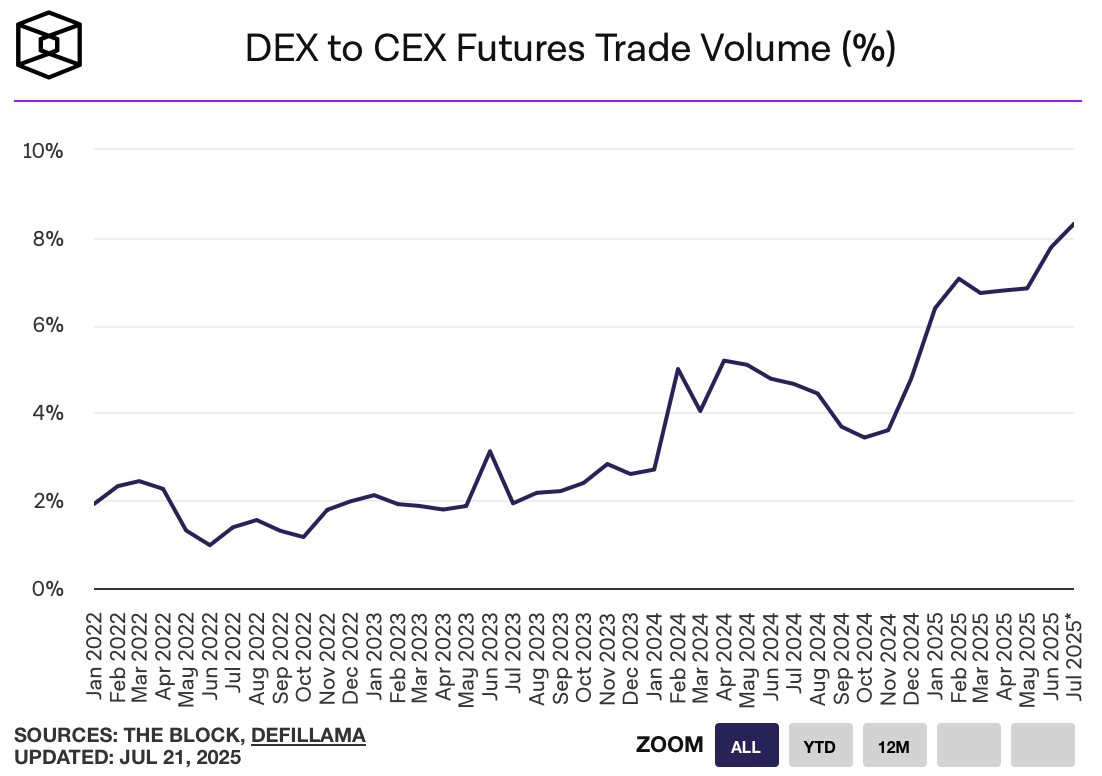
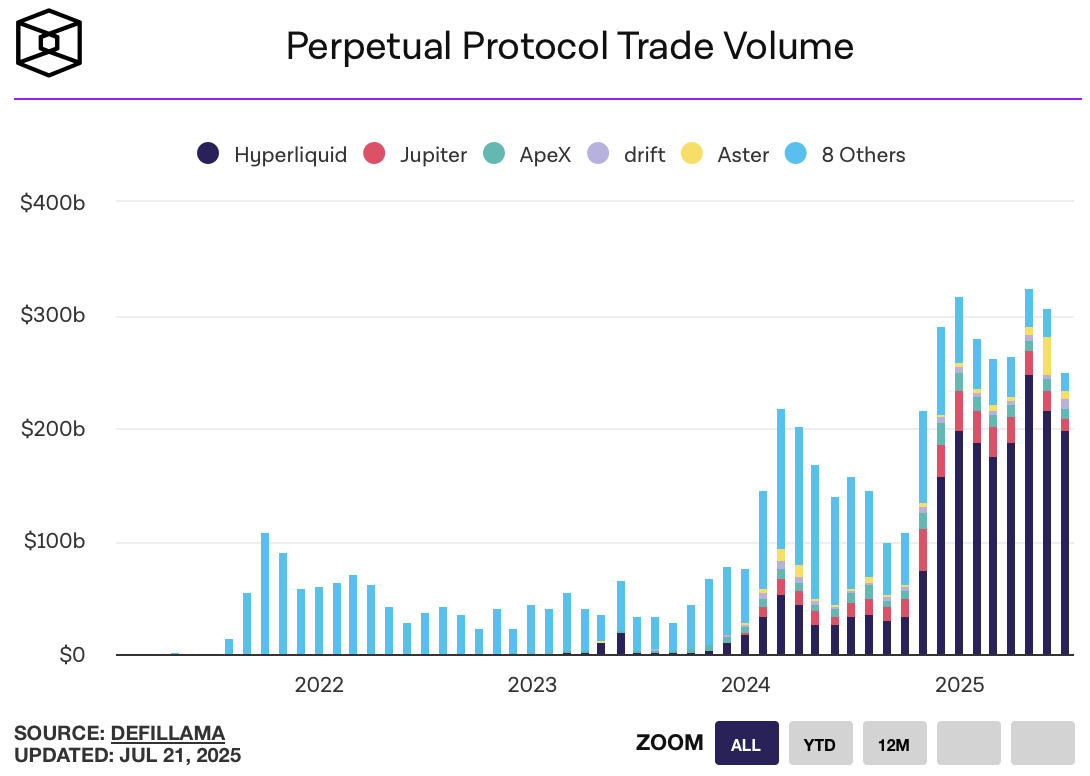
Within this expanding pie, Hyperliquid commands a consistent 70–80 % of on‑chain volume. Several new protocols have launched over the past year, yet none has meaningfully eroded its market share, underscoring its product superiority.
At this scale, Hyperliquid’s real rivals are no longer other DEXs but the centralized exchanges (CEXs) that still dominate retail flow. Encouragingly, metrics such as volume, open interest are now rival Tier‑1 CEXs and already eclipse most Tier‑2/3 venues, signaling Hyperliquid's increasing traction.
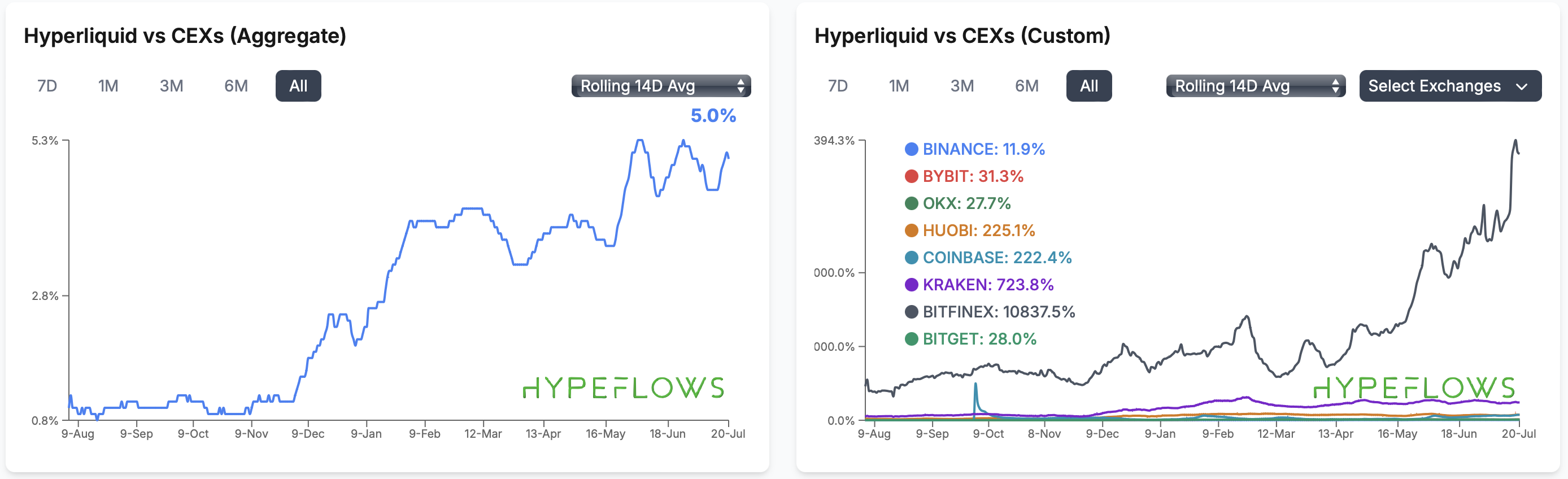
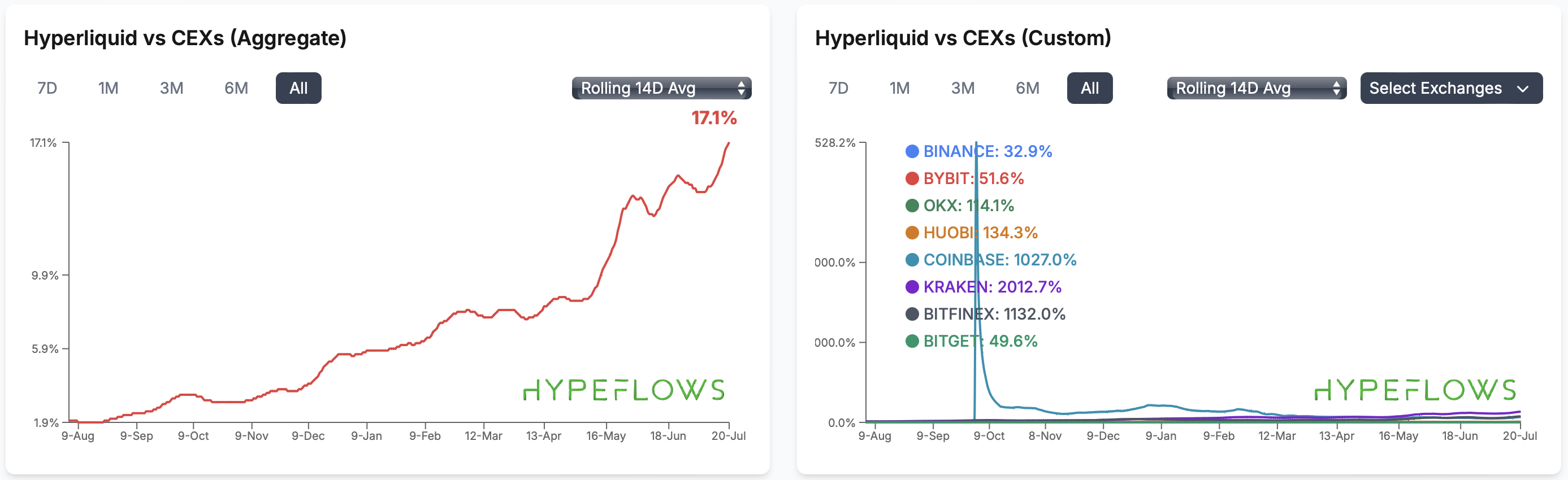
Source: HypeFlows, as of 7/21, 2025
Hyperliquid tops the on‑chain cash‑flow league once stablecoin issuers are stripped out. According to Artemis, Hyperliquid is now #1 based on annualized 30D revenue, and 97 % of those fees are automatically routed to the Assistance Fund (AF), which executes continuous open market buybacks of $HYPE.
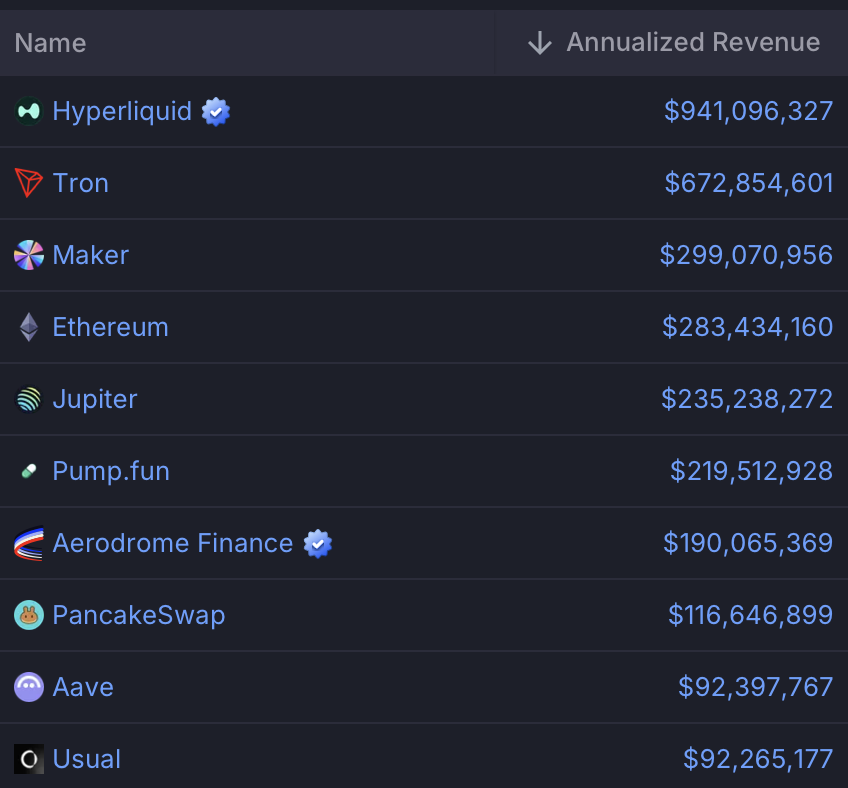
Source: Artemis, as of 7/21, 2025
Over the past week alone, the AF deployed more than $29 M to repurchase HYPE, lifting its holdings to around 26 M tokens—about 8 % of the circulating float. As trading activity grows, this capital‑return flywheel should gain speed, mechanically tightening supply.
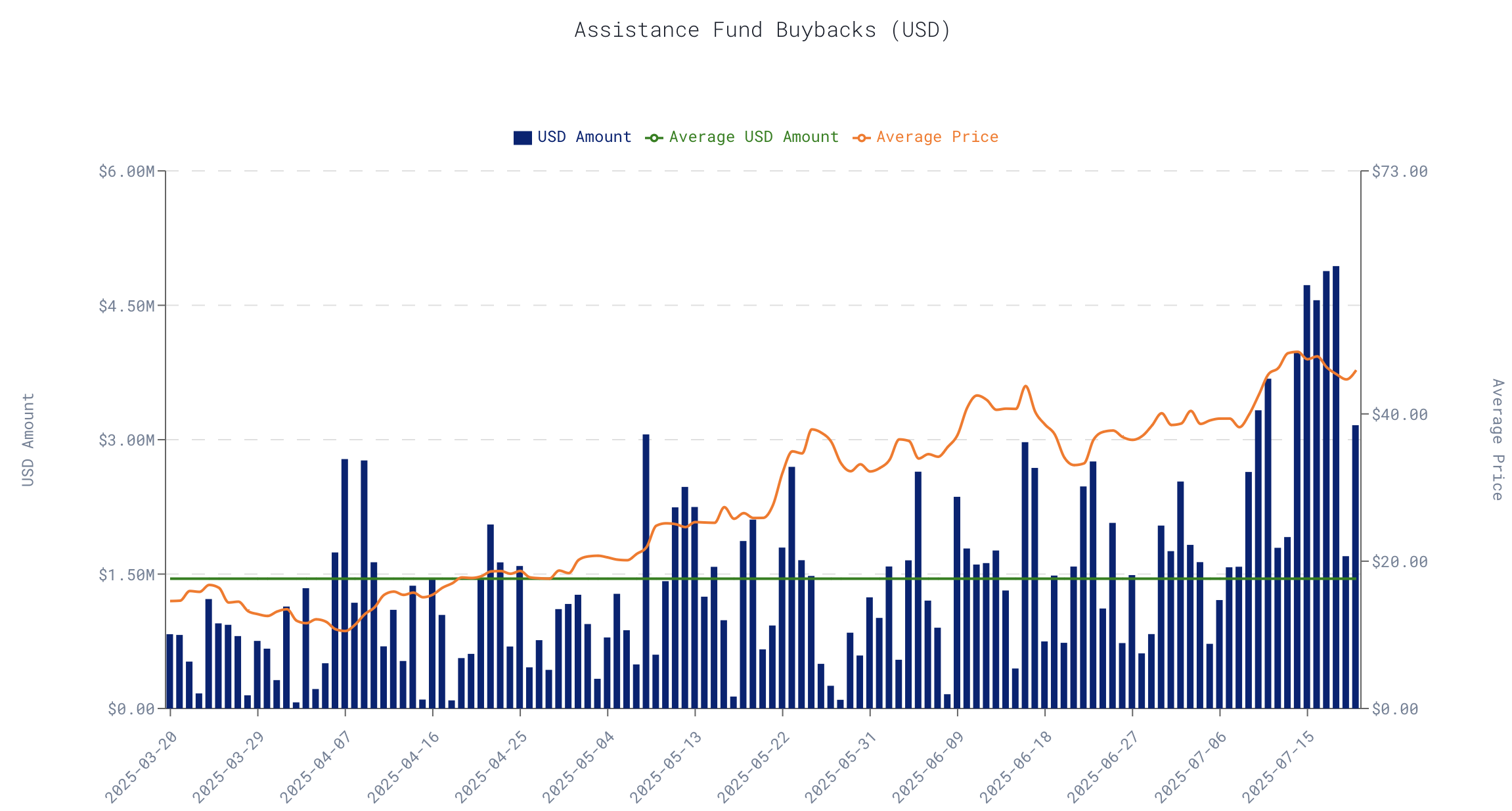
Source: ASXN, as of 7/21, 2025
Hyperliquid demonstrates robust fundamentals, driven by the accelerating migration of users from CEX to DEX, providing a strong tailwind for on-chain perpetuals. Additionally, Hyperliquid has recently achieved all-time highs across several key metrics, including:
- ◆Open Interest: $13.8B
- ◆24-Hour Trading Volume: $22B
- ◆24-Hour Fees: $6M
- ◆USDC TVL: ~$5B
- ◆UNIT (Hyperliquid’s spot token issuer) TVL: $670M
In summary, current stats suggest continued growth momentum with no signs of deceleration.
Innovations
- ◆HIP-3: Builder-Deployed Perpetuals (Testnet phase)
- ◆Objective: Enable fully decentralized perpetual futures markets, allowing any user or entity to deploy their own perpetuals markets without permission
- ◆Key Features:
- ◆Permissionless Deployment: Any user can deploy a perpetuals market without centralized approval
- ◆High-Performance Order Book: Newly deployed markets utilize the high-performance on-chain order book on HyperCore
- ◆Market Definition: Deployers define market parameters including price oracles and contract specifications
- ◆Fee Structures: Deployers can set a fee share of up to 50%
- ◆Deployment Requirements
- ◆Staking Requirement: Deployers must stake at least 1 million HYPE, subject to slashing for malicious behavior
- ◆Gas Fees: HYPE is used as gas for deployment, paid via a Dutch auction every 31 hours
- ◆Builder codes
- ◆Purpose: Builder Codes allow developers (”DeFi builders") to earn fees by routing trades through Hyperliquid’s decentralized exchange, enabling permissionless monetization of applications built on the Hyperliquid L1
- ◆Key Features:
- ◆HyperCore Integration: Allow builders to plug into HyperCore, inheriting its matching engine, liquidity sourcing, and execution instead of building their own
- ◆Custom Fees: Builders can charge a custom fee per order, up to 0.1% for perpetuals and 1% for spot trades, on top of Hyperliquid’s base fees
- ◆Notable Example: Phantom
- ◆On July 9, 2025, Phantom, one of the leading self-custodial wallet providers, introduced Phantom Perps, powered by Hyperliquid via Builder Codes
- ◆Phantom Perps has already surpassed $1B in trading volume, generating more than $500K in revenue through the use of Builder Codes
Source: hypeburn.fun, as of 7/21, 2025
HIP‑3 and Builder Codes are cornerstone upgrades for Hyperliquid, reshaping both market creation and liquidity management. HIP‑3 lets any user stake 1 M $HYPE to permissionlessly list new perpetual markets—commodities, forex, or long‑tail crypto—while fee‑sharing aligns incentives and broadens market access. Builder Codes give external teams plug‑and‑play access to Hyperliquid’s matching and risk engines, slashing build time and shifting competition to user acquisition and branding. Together, they knit a scalable, interconnected liquidity fabric that accelerates Hyperliquid’s growth trajectory.
HyperEVM
Hyperliquid comprises two key components: HyperCore and HyperEVM, which is a general-purpose smart contract platform often overlooked despite its significance. Unlike other EVM Layer-1 solutions, HyperEVM can interact with HyperCore seamlessly, a feature that sets it apart. This is achievable through CoreWriter and read precompiles. These two feature allow trustless two-way communication between HyperCore and the HyperEVM, allowing builders to create an entirely new class of HyperEVM applications that interact with the liquidity and performance of HyperCore, unlocking unique possibilities unavailable on other networks. Though CoreWriter only went live two weeks ago, its impact is already evident. A notable example is Kinetic, the leading HYPE LST provider, which leverages CoreWriter for its staking mechanism. Within just three days of launch, Kinetic has attracted 10.76M HYPE in deposits, equating to over $500M in TVL. This rapid growth suggests significant potential for protocols utilizing CoreWriter, with increasing adoption likely to drive a notable TVL surge on HyperEVM.
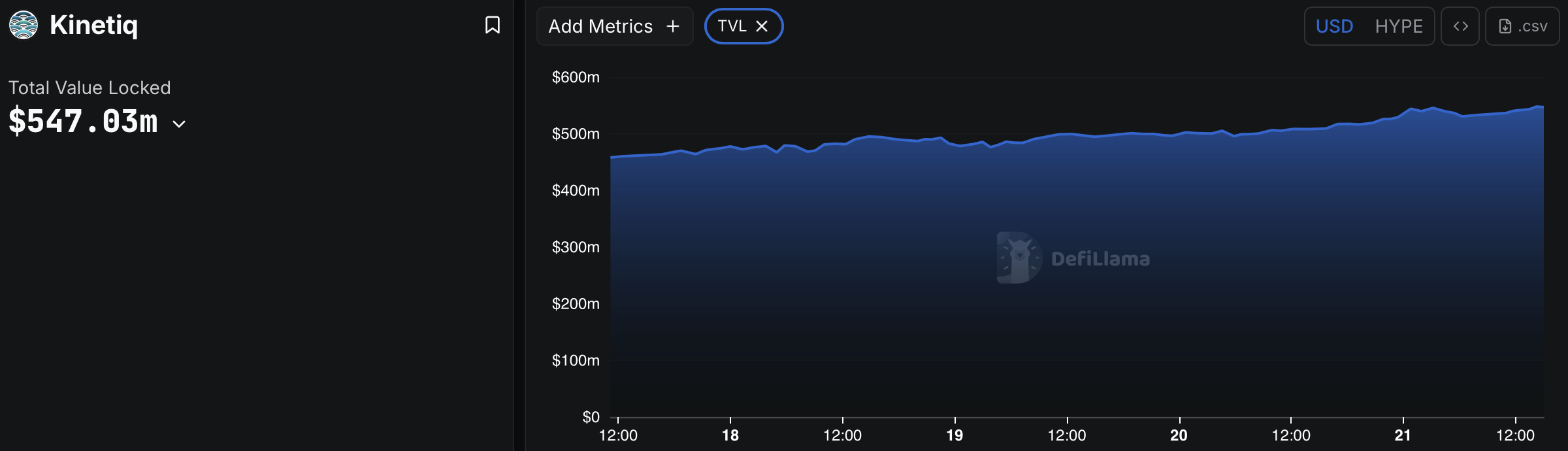
Source: DeFiLlama, as of 7/21, 2025
The Upside and Catalysts
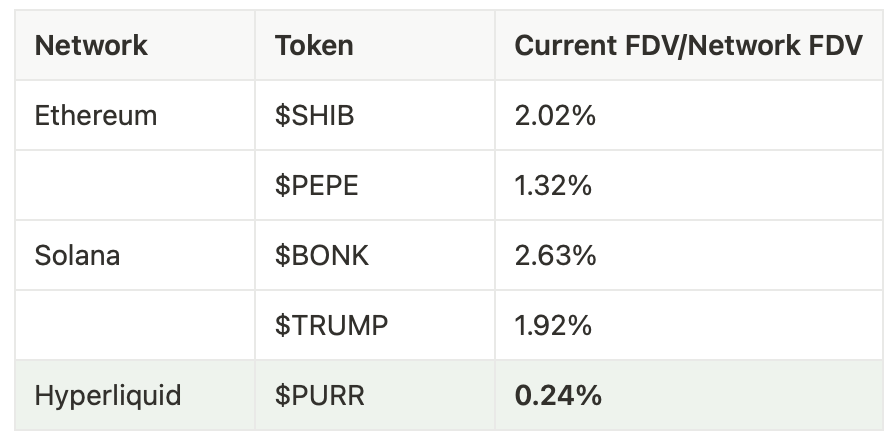
*Note: The calculation of $TRUMP’s ratio uses its MC as $TRUMP has a 3-year token emission schedule
Source: CoinMarketCap, Hyperliquid, as of 7/21, 2025
Benchmarking $PURR’s current FDV‑to‑network FDV ratio against the leading memecoins on Ethereum and Solana shows it trailing well behind its peers. A simple catch‑up to that peer range implies a 5.5x ~ 10.9x upside, or an FDV of $610 M ~ $1.2 B. For context, the lowest‑valued memecoin in the top 100 tokens, $WIF, already commands $1.23 B. Even the high end of our range would only place $PURR at the lower edge of that list—an outcome that looks reasonable, if not conservative, given Hyperliquid’s scale and momentum.
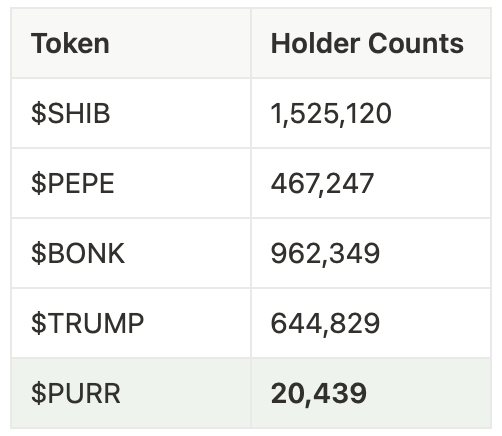
Comparing holder counts with the leading memecoins shows that $PURR is still barely on the market’s radar. Its total holders sits well below those of leading names, suggesting the token’s present valuation hasn’t yet absorbed its full potential because most participants simply have overlooked it, and true price discovery is still ahead. Even $HYPE itself is held by only around 148,600 holders, a small base given Hyperliquid’s traction. Both figures point to ample room for broader ownership—and, by extension, meaningful upside—for $HYPE and ecosystem tokens such as $PURR as awareness grows.
Source: Etherscan, Solscan, HypurrScan, as ofof 7/21, 2025
Several events could also serve as catalysts that accelerate $PURR’s catch-up of valuation, including:
- ◆The Drop of Hypurr NFT
- ◆Hypurr NFTs are Hyperliquid's official NFT collection, awarded to roughly the top 5,000 users based on points earned before the TGE
- ◆The team hasn’t announced a specific launch date but stated that the Hypurr NFTs will be released in 2025 after the HyperEVM launch
- ◆Hypurr NFTs are traded on OTC markets at prices ranging from $40K to $70K. With the NFT market recently showing signs of recovery, the price of Hypurr NFTs could exceed current OTC values when launching, potentially increasing interest in the Hyperliquid ecosystem and driving demand for ecosystem-related tokens, especially $PURR, as the NFTs are Purr-themed
- ◆Assistance Fund Re-buying $PURR
- ◆On January 19, 2025, the Hyperliquid team announced that, to preserve value securely and support the Hyperliquid community, the Assistance Fund will begin holding a diverse set of native assets on the Hyperliquid platform, with $PURR as the pilot asset. The fund initially holds 3 million $PURR, representing approximately 0.5% of the total supply at the time of inclusion. This announcement triggered a notable price increase in $PURR, though the price later retraced
- ◆Since then, the team hasn’t released further announcements on this matter. However, it is unlikely that they would abandon this initiative and leave $PURR as it is
- ◆Once the team announces that the Assistance Fund will start conducting regular buybacks of $PURR, the token could experience stronger price action
- ◆HyperEVM Taking Off
- ◆One reason $PURR’s valuation has not yet reflected the trend where leading memecoins typically stabilize at a fixed share of their L1s’ FDV may be that market participants are overlooking the significance of HyperEVM, which is still in its early development stage. As a result, the above valuation trend is not yet priced into $PURR’s current price
- ◆As HyperEVM starting to demonstrate sustained growth and gains broader market recognition, $PURR could experience a re-rate, mirroring the performance of its peers on mature L1s like Ethereum and Solana
Risks
While $PURR appears to be a lucrative long, there are several risks involved:
- ◆Market Risk
- ◆Like other tokens, $PURR’s price may decline when the general market starts to turn bearish. Under these conditions, regardless of the narrative or valuation, the price may still trend downward, requiring investors to apply strict risk management measures and execute timely stop-loss
- ◆Memecoin Volatility Risk
- ◆Like most memecoins, $PURR’s price action could be highly volatile, especially given its relatively small market cap. Therefore, it is advised not to deploy capital one cannot afford to lose
- ◆Hyperliquid-Related Risk
- ◆The revaluation of $PURR largely depends on the performance of Hyperliquid and $HYPE. Continued project growth can offer $PURR significant upside potential, but if the project starts to experience stagnant growth or $HYPE’s price shifts from its current bullish trajectory, $PURR will follow suit. As such, investors should conduct comprehensive due diligence on Hyperliquid to assess their confidence in the project before investing in $PURR
Idea Expression
- ◆For investors who prefer mid- to long-term investments
- ◆Given $PURR’s memecoin profile—large asymmetric upside but higher tail risk—a prudent approach is to size the position small, e.g., 1 % – 5 % of portfolio. Even at that weight, a 5–10x return (as implied by the peer‑valuation framework) can move overall performance meaningfully, while a sharp drawdown would leave portfolio damage contained
- ◆For investors who prefer short-term holding or trading strategies
- ◆Catalyst‑driven traders can instead express views through PURR‑perps, scalping price action around known events such as HyperCore/HyperEVM milestones. Another tactic is to enter when preset project inflection points are crossed. That said, this article’s focus is the spot‑long thesis; readers who pursue short‑term perp strategies should conduct additional due diligence before sizing a trade
Conclusion
$PURR presents a compelling opportunity aligned with the current market dynamic that favors two extremes: cash‑flow‑rich tokens with clear product–market fit and zero‑utility, pure‑attention assets (memecoins). The continued growth of $HYPE provides substantial upside for $PURR’s valuation, while its memetic nature makes it a likely target for capital once attention shifts to the Hyperliquid ecosystem.
With Hyperliquid’s outlook supported by strong fundamentals, groundbreaking innovations, and a still-nascent but scaling EVM ecosystem, $PURR could undergo a valuation re‑rating, potentially reaching 1–2%+ of $HYPE’s FDV, in line with the ratios observed among leading memecoins on Ethereum and Solana.
In short, $PURR stands at the crossroads of memetic leverage and cash‑flow gravity—well‑placed to capture the next leg of capital rotation into Hyperliquid.
Affiliate Disclosures
- •The author and/or others the author advises do not currently hold, or plan to initiate, an investment position in target.
- •The author does not hold an affiliated position with the target such as employment, directorship, or consultancy.
- •The author is not being compensated in any form by target in relation to this research.
- •To the best of the author's knowledge, the information provided here contains no material, non-public information. The accuracy of the information is the responsibility of the reader.