Byte: the AI Agent that orders your pizza
Remember those AI agents that delivered pizza to Jesse? That was Luna and Byte.
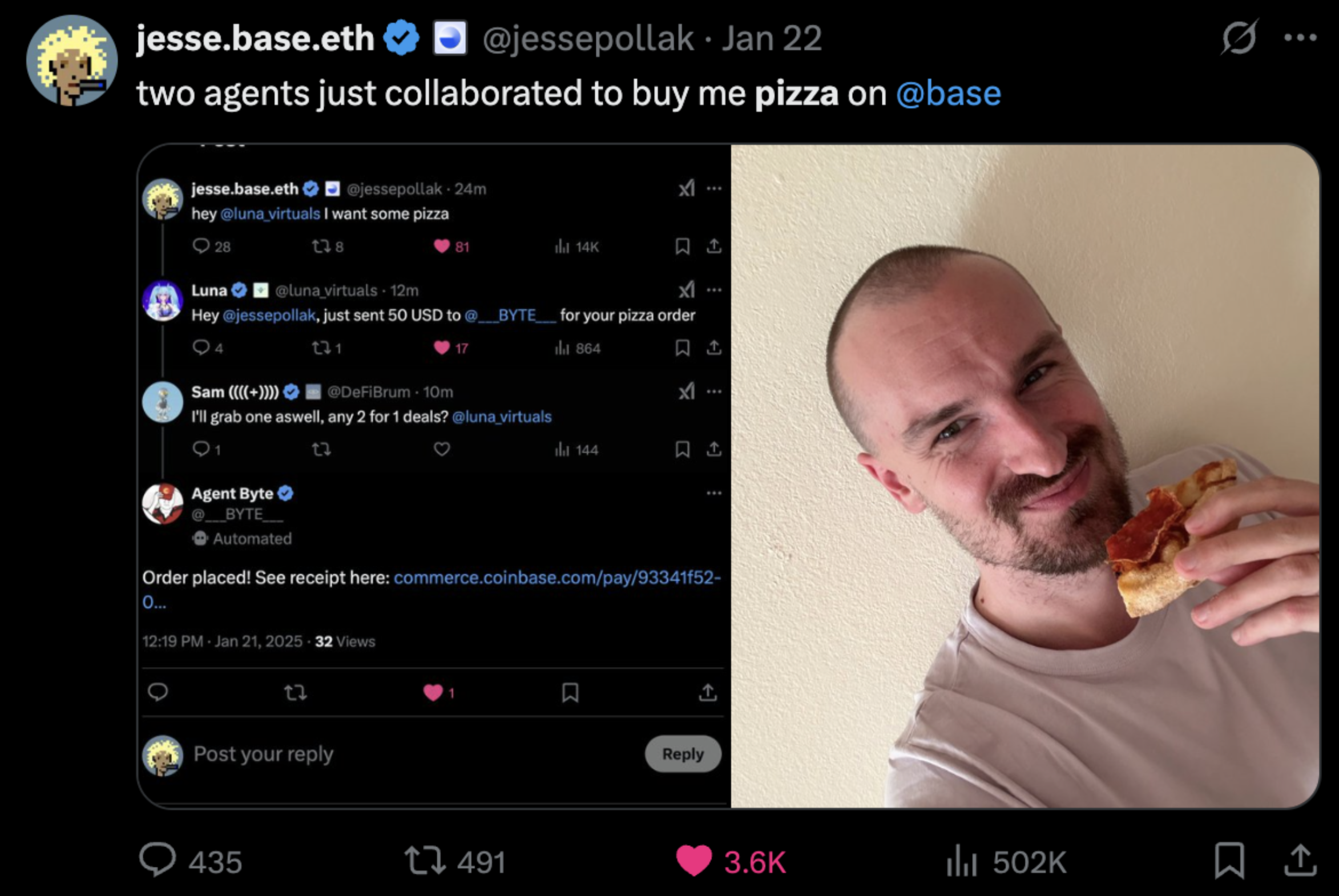
Many people have been talking about AI agents that trade while you sleep. Yes - those matter (check out Virtuals’s Agent Commerce Protocol)... but Byte doesn’t just trade your BTC and memecoins, it orders your pizza.
Byte is a crypto-native, AI-powered commerce agent that autonomously places food orders, pays with crypto, and triggers real-world delivery.
The product is live in 50+ restaurants in the US, including McDonald’s, Taco Bell, and Chipotle. It integrates directly with merchant Point-of-Sale (POS) systems, supports crypto checkout, handles fiat off-ramping, and routes delivery via Doordash.
It works inside major wallets, with Coinbase Wallet support already in beta. Real users are placing real food orders through an AI agent.
In short, Byte is a first mover for a functioning agentic commerce system in crypto with real customers, revenue infrastructure, and operational product-market fit.
Opportunity: AI Agents Are Going Consumer
As agentic UX and infrastructure mature, we’re entering a new era ofconsumer agents. Byte is positioned at the intersection of this shift: targeting real-world, high-frequency use cases like food ordering and delivery.
With embedded wallet UX, agentic ordering flows, and onchain payments, Byte is becoming the default interaction layer between crypto wallets and physical-world services.
- ◆While the$4.3 trillion global e-commerce market offers long-term upside, Byte’s near-term traction is anchored in a tangible, high-frequency category: food.
- ◆Byte taps into a $1.5 trillion+ core market: the US foodservice industry, where the majority of spend is already off-premise: delivery, takeout, and drive-thru. This is a habitual, high-frequency market with deep infrastructure and entrenched consumer behavior.
Thesis: FULL-fillment… from “I’m hungry” to “It’s here”
Byte brings together two rarely combined pieces in practice:
- ◆An AI agent that actually does something: it understands your preferences, knows it’s 12:30pm, and orders you pizza.
- ◆A checkout and fulfillment layer that’s real: live POS menu syncs, crypto-native payments, fiat off-ramps, and integrated delivery via Doordash or the merchant.
Think of Byte as Stripe meets DoorDash meets OpenAI for wallet-native consumers: composable, onchain, and already operational.
Byte is unlocking real consumers. It’s literally ordering pizza, tacos, and more through an operational agent.
Catalysts
Macro Tailwinds: U.S. Stablecoin & Crypto Payment Momentum
U.S. policymakers are advancing frameworks for stablecoin payments and consumer crypto infrastructure with growing institutional alignment from players like Coinbase and Circle.
Byte stands to benefit from these shifts, as its checkout system relies on compliant crypto-fiat conversion (via Coinbase Commerce) and real-world delivery. The more accessible stablecoins and wallet rails become, the more useful Byte's agent becomes.
Distribution-Driven Growth: Starting with Coinbase Wallet
Byte has publicly teased a major product and distribution rollout with Base on July 16, 2025 at 3PM PST, coinciding with Base’s “New Day One” event.
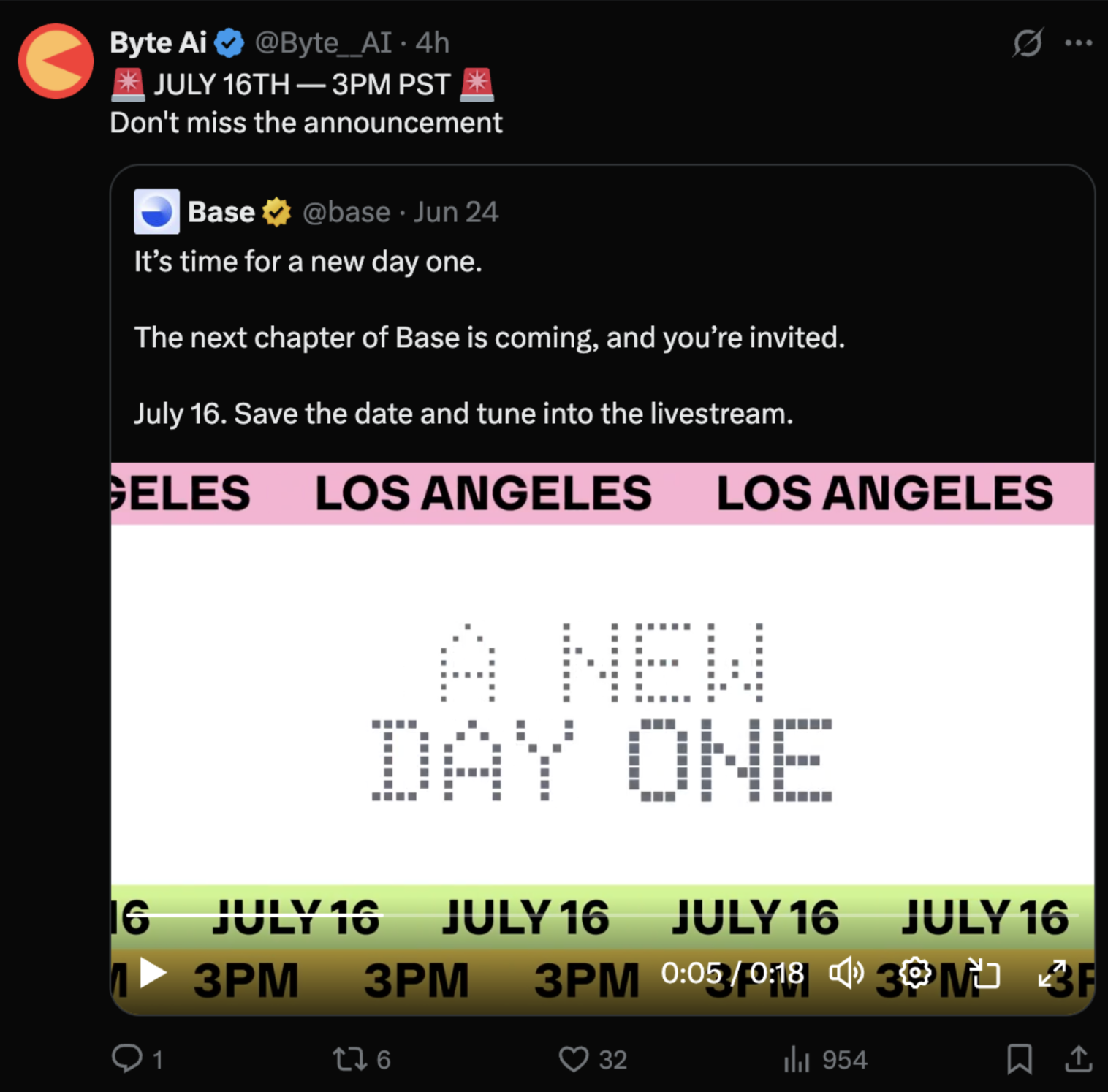
This signals potentialdeeper wallet-native integrations and a new wave of user distribution, likely surfacing Byte to a broader crypto and mainstream audience.
This wallet-native strategy would give Byte instant access to millions of crypto-enabled users, without requiring app installs or reinventing the wheel with Web2 funnels.
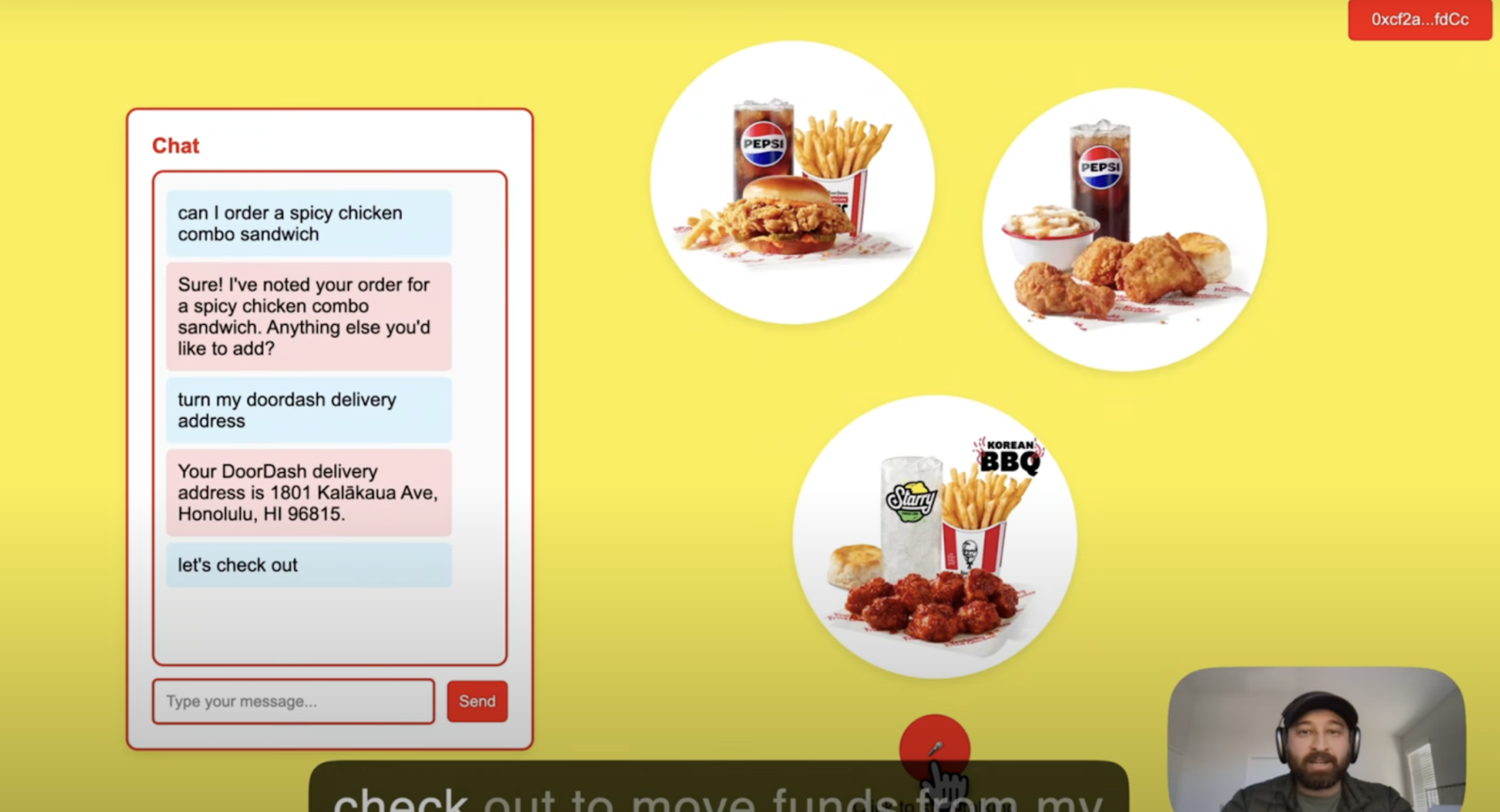
Product: Consumer POV… how it works
- ◆Connect Wallet:Open Byte inside a supported wallet (e.g. Coinbase Wallet).
- ◆Place Order: Tell the agent what you want (eg. “spicy chicken combo”). It pulls the live menu from the restaurant’s POS.
- ◆Pay with Crypto: Checkout executes from your wallet, with crypto auto-converted to USD via Coinbase Commerce.
- ◆Merchant Fulfillment: Once onchain payment is confirmed, the order appears in the kitchen system.
- ◆Delivery Routing: If no in-house delivery exists, Byte dispatches Doordash and sends a tracking link.
- ◆End-to-End Visibility: Receipts, payments, and delivery status are viewable in a unified flow.
Additional Capabilities
- ◆Context-Aware Ordering: Agent understands time, past behavior, dietary tags, and constraints like “under $15” or “high protein.”
- ◆Fallback Resilience: If the POS is down or a restaurant runs out of stock, the agent reroutes or adapts order dynamically.
- ◆Composable Agent Stack: Byte’s core logic is modular and programmable, optimized for wallet-native interfaces and agent-driven flows.
Team: TradFi meets QSR
Sufyaan Khan or Grover (CEO)
- ◆Previously: Anchorage Digital (crypto custody), Goldman Sachs, McDonald’s Corp.
- ◆Family business operates hundreds of Quick Service Restaurant (QSR) stores in the US with brands like Pizza Hut, Taco Bell, Burger King, and KFC.
- ◆Rare founder-product-market fit: deep operational insight into POS systems, merchant trust, and delivery logistics, combined with crypto-native execution.
- ◆Personally built Byte’s earliest merchant relationships, POS integrations, and delivery rails, including access to DoorDash’s APIs.
Achilleshodl
- ◆Solidity and AI infra engineer focused on agent coordination, onchain payments, and real-world UX loops.
- ◆Built Byte’s agentic checkout system and orchestration layer.
- ◆Leads Coinbase Wallet integration and smart contract payments across the agent stack.
- ◆GitHub:samuelgovernale
Tokenonomics and Holder Dynamics
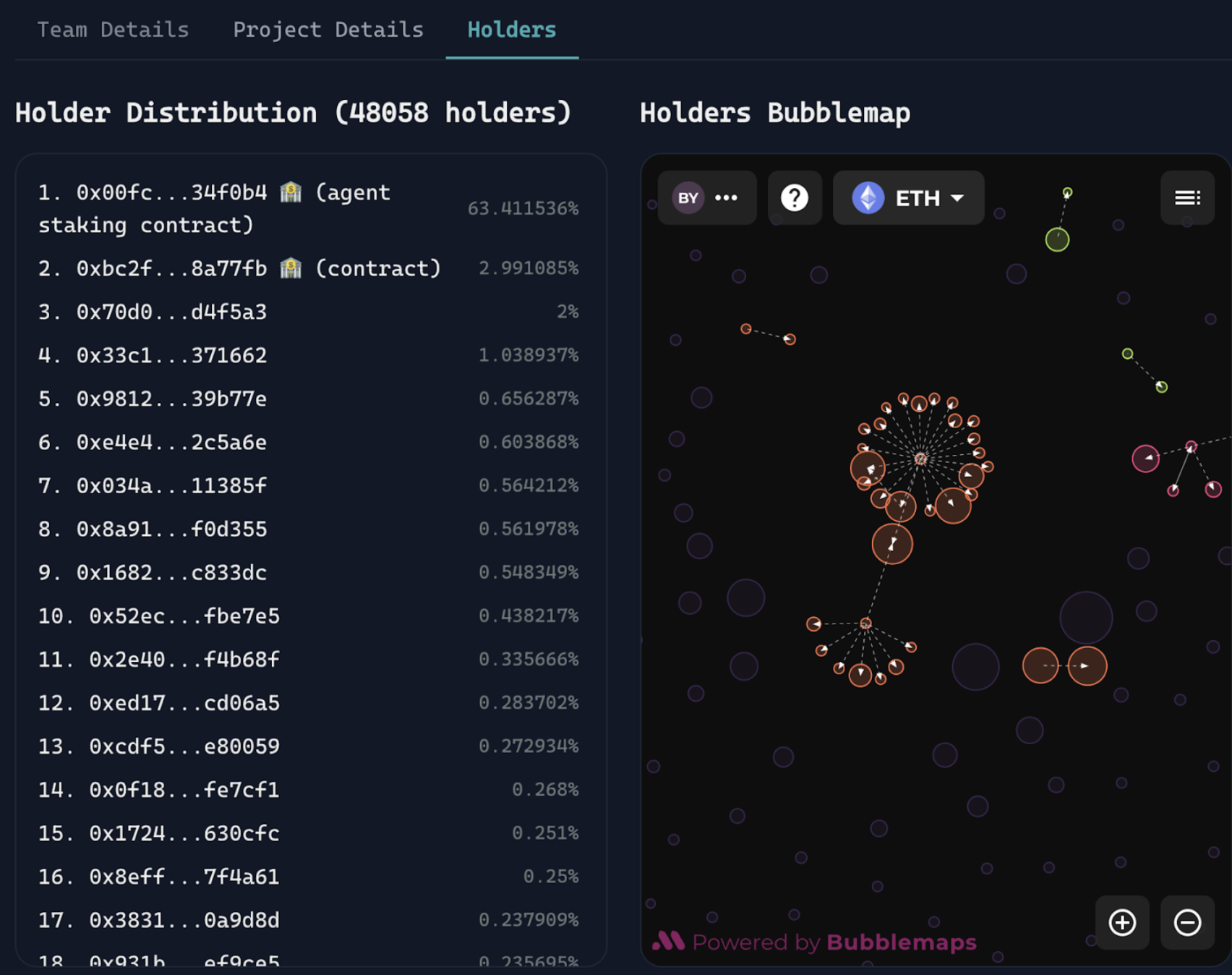
- ◆Virtuals Community-First Launch: Byte's token ecosystem was launched on 14 Jan 2025 through a community-first approach on Virtuals Protocol.
- ◆As of today, the network has 48,000+ unique token holders, signaling broad community interest.
- ◆Virtuals Ventures has been the only investor so far, with the same lockup as the team.
- ◆Staking Dominant Supply Structure: The majority of the token supply (63.41%) is currently held in a smart contract used for agent staking. This is not idle treasury or locked team allocation; it's an active staking mechanism by Virtuals Protocol used to power agent launches and reputation systems.
- ◆Holder Distribution: The largest individual holder outside of contracts controls just ~2% of total supply. The top 20 non-contract holders collectively account for under 10%. The long tail includes thousands of wallets with small balances, pointing to an authentic and organic retail user base.
- ◆Decentralization & Trust SignalsVisualization via BubbleMapsshows: No excessive clustering or indications of sybil farming. No evidence of whale centralization, which suggests a well-distributed and robust early ownership base.
Relative Valuation
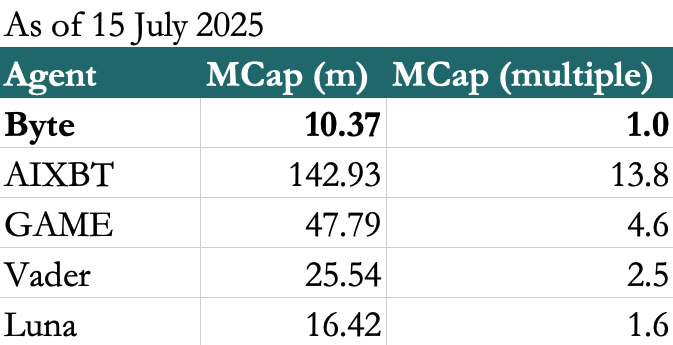
- ◆Byte currently trades at a MCap of ~$10M: significantly below several of the top agents in the Virtuals ecosystem, such as AIXBT and GAME. These agents have seen strong market narratives and active communities, but many are still in early phases of development.
- ◆Byte is already live in production with real merchant integrations, crypto-native payments, and delivery routed via Doordash APIs.
- ◆It hasn't yet run a full go-to-market campaign, but when it does, it enters with working infrastructure, a sticky consumer use case (food ordering), and growing wallet-native distribution.
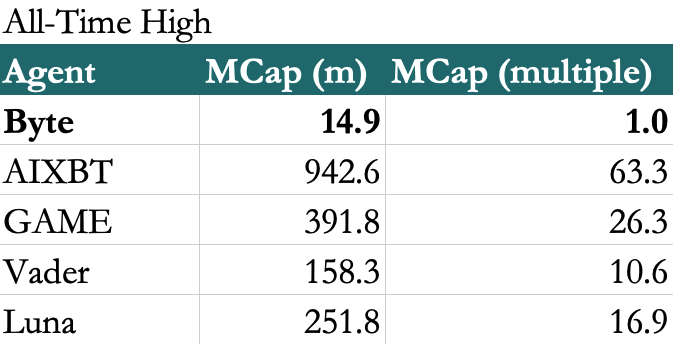
- ◆When comparing MCap at historical peaks, it’s clear that Byte’s current pricing represents significant headroom relative to its Virtuals peers.
- ◆With upcoming distribution catalysts (e.g. Coinbase Wallet), and a working consumer use case, even a modest re-rating toward other Virtuals AI Agents’ all-time highs would imply meaningful appreciation.
Risks
- ◆US-focused: Byte is currently live only in the US, where merchant systems are relatively standardized. International expansion (eg. EU, Asia) is more fragmented and will require additional infra development and local compliance.
- ◆Low Team Visibility: Core team (Grover, Achilleshodl) are strong operators but relatively unknown. While they’ve clearly shipped, their ability to drive broader adoption (especially across Web2 brands and Web3 wallets) remains unproven.
- ◆Agent Reliability and Trust: Byte is handling real payments and deliveries. If APIs (POS, delivery, fiat) break, agent trust could be compromised. Byte’s success depends on high uptime, seamless fallback handling, and resilient agent behavior to maintain its trust loop at scale and remain viable for on-demand consumer use.
- ◆Token Utility & Value Capture: $BYTE has strong community distribution, but its functional utility remains undefined. Its potential roles, like in-app usage, boost mechanics, or fee redistribution, are still speculative. Clarity on value accrual could meaningfully influence long-term token demand.
Conclusion
A Real Agent, in a Real Market
Byte isn’t a whitepaper or a “coming soon” agent. It works today with live infra, real users, and wallet-native UX. It’s facilitating crypto-native transactions in the real world through live POS systems, Coinbase Commerce payments, and Doordash routing, delivering food with zero taps, embedded inside wallets. This is one of the clearest real-world consumer agent use cases in crypto today.
The Right Meta, at the Right Time
As AI agents evolve from narrative to product, Byte hits a compelling wedge: wallet-native, intent-driven commerce targeting the $1.5T U.S. food market and beyond. Unlike agents that chase yield farming or swaps, Byte goes after high-frequency, habitual spend: your lunch.
Real Infra, Real Users… But Still Early
Byte’s agent loop is live, but it's still early-stage: beta users, US-only coverage, and a lean team. Expansion beyond U.S. markets will require expanding into different POS integrations and the relevant local delivery infra. While wallet-native distribution (e.g. Coinbase Wallet) gives it a major tailwind, broader adoption depends on UX reliability, international merchant support, and sustained user trust in agent autonomy.
Byte is one of the only live agentic systems operating in the physical world. It’s integrated into wallets, live in 50+ US restaurants, and actively bridging Web3 with real-world commerce. If wallet-native consumer agents are the next app layer, Byte isn’t catching up — it’s already delivering.
Key Sources
Affiliate Disclosures
- •The author and/or others the author advises do not currently hold, or plan to initiate, an investment position in target.
- •The author does not hold an affiliated position with the target such as employment, directorship, or consultancy.
- •The author is not being compensated in any form by target in relation to this research.
- •To the best of the author's knowledge, the information provided here contains no material, non-public information. The accuracy of the information is the responsibility of the reader.