PERSON DIRECTORY
Tim Scarfe
Host of Machine Learning Street Talk. Tim Scarfe appears in 43 indexed conversations across Machine Learning Street Talk. This directory brings every appearance, source, TL;DR, digest, and transcript into one searchable feed.

How a Voice Agent Learns the Rhythm of Conversation — Shawn Wen
Tim ScarfeTsung-Hsien (Shawn) Wen
Enterprise voice is shifting from commoditized ASR, LLM, and TTS components toward audio-native turn-taking that recognizes pace, hesitation, noise, and unfinished meaning while retaining text for guardrails and auditability.Production conversation data, self-hosting, precomputation, and latency-budgeted reasoning target the real bottleneck—when to respond—while a planned benchmark within “the next month or two” will test whether evaluation and control become the enterprise value layer; privacy and adoption remain unresolved risks.

How Deep Learning Finally Cracked Messy Tables - Frank Hutter
TabPFN signals a breakthrough in tabular AI, outperforming CatBoost and XGBoost through in-context learning rather than dataset-specific training.Synthetic training gives Prior Labs control over priors without leakage or memorization, while scaling from 1K to 1M rows and outperforming Google’s TabFM on speed.SAP-backed distribution targets agentic API usage, while Do-PFN’s potential to reduce RCT requirements remains a high-stakes, theory-dependent catalyst.

Why Scientific Taste Must Be Learned Through Practice — Edward Hughes
Agent Faraday, a GRPO-post-trained Qwen 3.6 27B using a frontier coding agent, beat Claude, GLM-5.2, and GPT-5.5 Codex on held-out AI-for-science replication tasks.The result supports Inherent’s bet on putting generalizable capability into weights rather than harnesses, while cheating risks and hindsight evaluation remain execution tests for AI-accelerated R&D and autonomous labs.

Watching America Run Away With AI - Alistair Pullen (Cosine AI)
Cosine’s sovereign-AI strategy pairs UK-funded training compute with customer-owned inference, making a narrow, capital-disciplined build possible without financing token-serving infrastructure.Performance differentiation is shifting toward active parameters, post-training data and large-scale RL, but reward attribution, software verification, swarm complexity and export-control hardware dependence remain material execution risks.
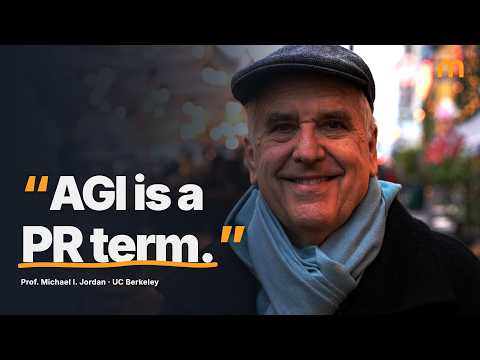
Intelligence is collective, not artificial — Prof. Michael I. Jordan (UC Berkeley / Inria)
Durable AI value may come from coordinating people, models, data owners, and incentives rather than building monolithic super-intelligence.Domain-specific systems combining prediction, fresh ground truth, uncertainty estimates, and human control could improve scientific tools, while privacy, labor, and creator compensation remain unresolved risks.

The Dangerous Illusion of AI Coding? - Jeremy Howard
AI can type most expert code while measured production output barely rises, exposing a gap between stochastic prompting gains and genuine software-engineering productivity.Howard’s stronger case is for bounded components under expert supervision and interactive, stateful tools, since opaque generated systems can accumulate understanding debt and weaken organizational adaptability.