PERSON DIRECTORY
Dr. Alexander Wissner-Gross
Dr. Alexander Wissner-Gross appears in 36 indexed conversations across Moonshots. This directory brings every appearance, source, TL;DR, digest, and transcript into one searchable feed.

Ask the Mates Anything Round #2 | MOONSHOTS AMA #293
Peter DiamandisSalim IsmailDave BlundinDr. Alexander Wissner-Gross
AI’s next control layer may be machine-on-machine oversight, using readable activations and truthful real-world contexts.Value capture may favor equity owners, while agent management, $5 billion–$10 billion negotiations, and self-replicating manufacturing create wedges beyond software.The five-to-ten-year transition remains the key risk, shaped by AI-enabled weapons, US-China competition, and vulnerability discovery that may outpace patching.
The $10B Satellite Empire Putting AI in Orbit, Why Chips Beat Rockets & China's #1 Open Model | #266
Peter DiamandisWill MarshallSalim IsmailDave BlundinDr. Alexander Wissner-Gross
Planet’s roughly 200 satellites generate 25 TB daily and a 150-PB, ten-year archive with 3,000 observations per land point, creating an irreproducible data moat as AI makes Earth searchable.Owl, Pelican, and Tanager add resolution, revisit rate, latency, and spectral depth, while orbital compute could become cost-competitive at $200-$300 per kilogram; inference efficiency, export policy, and GLM-5.2 remain key variables.
Anthropic Files $965B IPO, Trump Signs AI Executive Order, and ChatGPT Crosses 1B Users | EP #262
Peter DiamandisEmad MostaqueDave BlundinDr. Alexander Wissner-Gross
Anthropic’s confidential IPO could make frontier AI a public-market asset class; Polymarket assigns a 60% chance of valuation above $1.8 trillion.ChatGPT’s reported one billion monthly users make distribution central as falling intelligence costs intensify the race for each user’s coordinating assistant.Trump’s voluntary 30-day review and DNA-screening debate leave governance unresolved while robotics and longevity attract sovereign-scale capital.
SpaceX’ $75B+ Historic IPO, GPT5.5 Outperforms Polymarket, AI Solves 80yr old math problem | EP #257
Peter DiamandisSalim IsmailDave BlundinDr. Alexander Wissner-Gross
SpaceX’s proposed $75 billion IPO at a valuation probably above $1.75 trillion would give Musk a public acquisition currency, with Starlink and terrestrial data centers underpinning the infrastructure case.Starship V3’s 100-ton payload, orbital-refueling tests, and planned docking hardware are the near-term proof points for converting that narrative into a packet-switched transport network.GPT-5.5 Codex’s 25% FutureSim score and reported Super Bowl forecast win suggest prediction is becoming an AI advantage, while concentration of capital, compute, and financial interfaces remains a risk to monitor.
Google I/O 2026, Karpathy Joins Anthropic, and Cerebras’ $95B IPO | EP #256
Peter DiamandisSalim IsmailDave BlundinDr. Alexander Wissner-GrossAndrew Feldman
Google’s AI comeback is a distribution-and-infrastructure thesis: Gemini reached 900 million monthly users, AI Mode exceeded 1 billion, and projected CapEx is $180–190 billion as Spark and Search embed agents in defaults and commerce.Cerebras’ 68% IPO surge to a stated $95 billion market cap validates wafer-scale inference, but the more-than-$20 billion OpenAI deal and decades-long domestic-fab constraints leave demand and supply to monitor.
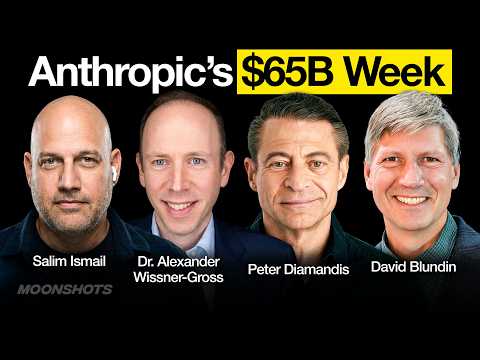
Google Invests $40B Into Anthropic, GPT 5.5 Drops, and Google Cloud Dominates | EP #252
Peter DiamandisSalim IsmailDave BlundinDr. Alexander Wissner-Gross
The frontier race is narrowing to OpenAI, Anthropic and Google as Chinese open-weight models reset the cost floor and shift competition toward inference-time reasoning.Kimi K2.6 reportedly trained for $4.66 million, coordinates 300 agents, and can cost one-eighth as much through Fireworks AI, while GPT-5.5 cuts tokens 40% and hallucinations 60%.Google’s TPU, NVIDIA, cloud and equity commitments strengthen its full-stack position, but powered land, energy and TSMC-class fabrication remain constraints worth monitoring.

Elon's $60B Cursor Bet, Claude kills SaaS, and OpenAI's Mass Departures | EP #249
Peter DiamandisSalim IsmailDave BlundinDr. Alexander Wissner-Gross
Claude Design’s launch pushed Figma down 10% and Adobe about 2%, signaling that frontier labs can reprice SaaS by unhobbling capabilities already latent in base models.Defensibility is shifting toward proprietary data, customer ownership, regulation, physical-world integration, and distribution as code generation, private compute, and Hormuz-linked supply shocks reshape competitive advantage and capital allocation.
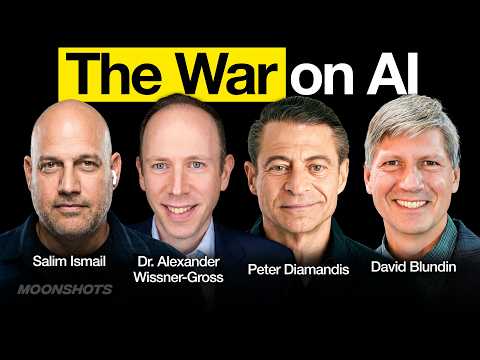
Sam Altman’s Attack, Amazon vs. Starlink, and What Opus 4.7 Actually Means | #248
Peter DiamandisSalim IsmailDave BlundinDr. Alexander Wissner-Gross
Claude Opus 4.7 appears a commercially meaningful point release, with better computer use, parallel agents, larger budgets, and three-times-larger image inputs rather than a Mythos-scale break.Meanwhile, software-engineering performance rose from 60% to 97%, GenAI adoption reached 53% in three years, and employment among US software developers aged 22-25 fell nearly 20% since 2024.Amazon’s reported $11.57 billion Globalstar acquisition makes globally cleared spectrum strategic against Starlink, as social license, labor displacement, and infrastructure buildout remain key constraints.
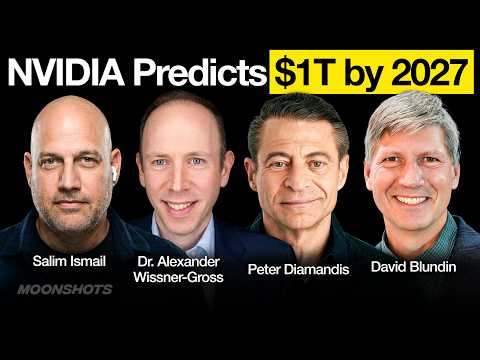
NVIDIA's $1 Trillion Prediction, Anthropic Beats OpenAI, Tesla vs. TSMC & The CS Job Collapse | 240
Peter DiamandisSalim IsmailDave BlundinDr. Alexander Wissner-Gross
NVIDIA’s path to “through 2027 at least $1 trillion” is a foundry-capacity thesis, supported by reportedly controlling 70% of TSMC’s 3-nanometer volume and roughly 80% gross margins.OpenClaw is reframing enterprise adoption around agent-to-agent workflows, while inference costs falling 1,000-fold from o1 to GPT-5.4 shift spending toward reasoning and action-time compute.Anthropic’s enterprise share rose from 40% to 73% of first-time customers in three months, but post-transformer architectures, ASML constraints, nuclear power, and labor disruption remain major variables.
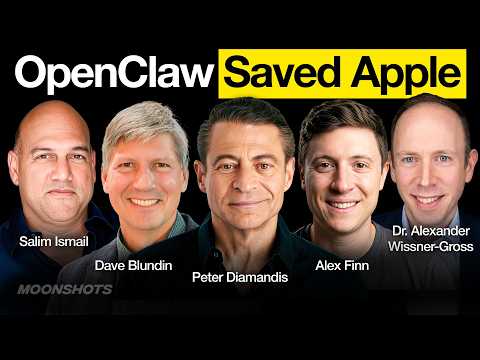
OpenClaw Explained: Baby AGI, Security Threats, Mac Mini Became Everyone's Supercomputer | #237
Alex FinnPeter DiamandisSalim IsmailDave BlundinDr. Alexander Wissner-Gross
OpenClaw shifts AI from on-demand answers to persistent, personalized work, with supervised multi-agent hierarchies showing better results than raw local-agent capacity.Mac mini demand signals a hardware opportunity for private inference, while gateway exploits, prompt injection, and rapid feature cloning threaten horizontal SaaS and favor secure vertical agents.