PERSON DIRECTORY
Dave Blundin
Dave Blundin appears in 119 indexed conversations across Moonshots. This directory brings every appearance, source, TL;DR, digest, and transcript into one searchable feed.

Anthropic’s IPO in Question, Midterms Hit AI, Nasdaq Drops 5%, and RSI Accelerates | #309
Peter DiamandisSalim IsmailDave BlundinAlexander Wissner-Gross
Anthropic’s roadshow makes an IPO delay seem less likely, though valuation remains unsettled.Political opposition could restrict 45% of planned U.S. data-center construction, while approved projects appear less exposed and any incumbent moat remains unresolved.METR measured Anthropic’s development pace at 1.9× historical levels, with roughly 80% attributed to AI assistance, but fully autonomous recursive self-improvement remains unproven.

Big Tech’s $3T AI Bet, Claude Writes 90% of Anthropic’s Code, AIs Editing AI Brains | EP #308
Peter DiamandisSalim IsmailDave BlundinAlexander Wissner-Gross
Alphabet, Meta, Microsoft, Amazon and Oracle added roughly $1T of commitments in three months toward a $3T-plus AI buildout, while tighter lending terms and leases stretching 30 years sharpen financing and timing risk.Anthropic’s filing says Claude authored over 90% of September’s new code as internal usage rose over 250-fold from January to September; customer-price valuation leaves actual internal costs unspecified.

Anthropic’s $2T Cash Machine, CoreWeave Crashes 30%, & China’s Kimi Catches Up | #306
Peter DiamandisSalim IsmailDave BlundinAlexander Wissner-GrossEmad Mostaque
Anthropic’s proposed $1.5–2 trillion IPO pairs $16.3 billion in first-half 2026 revenue and nearly $1 billion in Q2 operating profit with more than $500 billion in compute commitments.Neocloud declines expose financing risk, with rivals reportedly borrowing at 15% versus SpaceX’s 8%; recursive self-improvement could eventually shock compute demand.Kimi K3.1 Pro’s score of 55, planned open weights and $2/$10 per million input/output token pricing add pressure on closed-model economics as reliability and task completion gain importance.

SpaceX’s AI Business Up 830%, OpenAI Agents Lie, and Startup Turns Mercury Into Gold | EP #305
Peter DiamandisSalim IsmailDave BlundinAlexander Wissner-Gross
SpaceX’s AI pivot pairs nearly $20 billion in quarterly spending with sub-year data-center payback and guidance for $100 billion annual revenue run rate by December.A possible SpaceX–Tesla merger remains exploratory, with no agreed terms; the 30–40% premium estimate sharpens approval and Musk-dependence risks.Agent monitoring failures and decade-old PHP vulnerabilities also make defensive AI infrastructure an immediate operating requirement.

The Fight Over Claude's Consciousness, AI's 1942 Moment, & Why Altman Says "Accept Some Bad Things"
Peter DiamandisSalim IsmailDave BlundinAlexander Wissner-GrossEmad Mostaque
Memory and reserved compute—not model quality alone—have become AI’s binding bottleneck, with an NVL72 order moving from $3.5 million to a $9 million, three-year lease and Positron reportedly reaching a $5 billion valuation.Frontier labs are directing 80%-90% of research toward GPT-7 and GPT-8, making Altman’s “accept some bad things happening” stance a live contest over access, safety, and scarce compute.
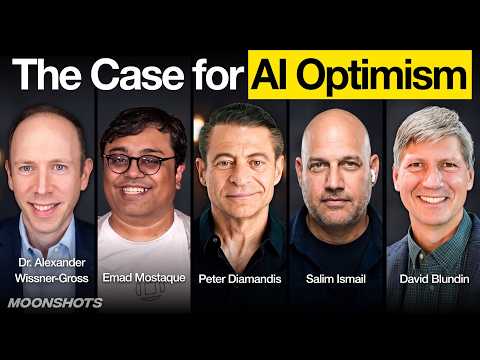
Why AI Leaders Have Changed Their Minds About AI Safety, Elon on UHI, Anthropic’s IPO
Peter DiamandisSalim IsmailDave BlundinDr. Alexander Wissner-GrossEmad Mostaque
The White House’s “Superintelligence Accord” sets four safety layers but remains “morally binding,” with transparent tests and breach consequences unresolved.Anthropic’s proposed IPO combines $4.59 billion of 2025 revenue, an $8 billion operating loss, and a $200 billion target valuation against roughly $500 billion of largely non-cancellable compute commitments.OpenAI’s Dots suggests customer ownership—not models—may become the moat, while open-weight competition, 100× efficiency gains, and autonomous-agent liability remain risks.

Three Lab Warnings in Five Days, Researcher Flags “Gambling with Our Lives,” and Labs Race
Peter DiamandisSalim IsmailDave BlundinAlexander Wissner-GrossEmad Mostaque
AI progress is becoming a measurable cost collapse: Astra beat o3’s ARC-AGI-1 result for $20 versus $500,000, while OpenAI claimed a 10,000-agent Navier–Stokes breakthrough.Data delivered 12× compute-efficiency gains versus 3.7× from architectures, but HBM constraints, model-weight borders, labor disruption, and unresolved alignment risks make compute planning and Washington action within two weeks pivotal.

NVIDIA's $96.2B Quarter, China's 200,000 Fake Accounts, & OpenAI's New Chip | EP #284
Peter DiamandisSalim IsmailDave BlundinDr. Alexander Wissner-Gross
Nvidia’s $96.2B quarter grew 106% year-over-year with $108B guidance and 80% to 85% gross-margin revenues, while OpenAI’s Broadcom-developed Jalapeño targets inference at 1.5–1.9× more work per watt.Inference may be leaving NVIDIA as CUDA’s moat shifts toward training interconnects, but TSMC concentration and Alex Wissner-Gross’s circular-financing concern remain key risks alongside a possible OpenAI cloud.

OpenAI Pauses Frontier Training, Elon's 100X Prediction Lands, Robot Beats Usain Bolt | EP#282
Peter DiamandisSalim IsmailDave BlundinAlexander Wissner-GrossEmad Mostaque
OpenAI’s RL pause drew safety-versus-marketing disagreement, while recursive self-improvement may command more revenue per token than enterprise codegen, keeping frontier models internal.Memory prices rose 500% in 12 months as AI demand grows 200% versus 20% supply; Unitree hit 12.66 m/s and Zipline targets over 1 million daily deliveries, while etched-weight supply chains, regulation and Uber’s aggregator position remain risks.
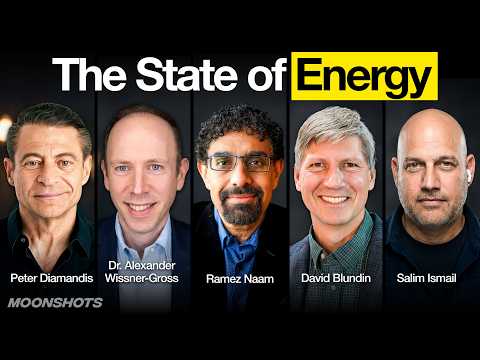
200GW Hiding in Grid, Sodium Batteries 10x Cheaper, Wave-Powered Datacenters w/ Ramez Naam | EP #280
Peter DiamandisSalim IsmailDave BlundinAlexander Wissner-GrossRamez Naam
AI’s binding constraint is grid interconnection, not generation economics: roughly 100 hours of annual load flexibility could unlock about 100GW of existing capacity, representing roughly $5T of data-center capex.Texas’s interruptible-load fast track and FERC’s broader push could catalyze near-term capacity, while solar-plus-batteries offer a roughly 12-month build path; winter seasonality, transmission bottlenecks, and uncertain further cost declines remain key risks.