Loading podcasts…
Language

市场概述2026年10月13日
周五数据显示,convexity hedging减少、swaption squeeze近尾声;但Shanghao Jin未核验更新数据,长端利率未降而波动率回落。油价仍是尾部风险,利率上升可能重新触发对冲。AI债权人承担近似股权的需求风险,融资与再融资压力下,CSP现金流是关键验证。

Martin Shkreli: Big Pharma's Blind Spot, Betting Against Quantum & What Prison Taught Him
Shkreli limits quantum’s edge to factoring and elliptic-curve logarithms; current machines lack quantum RAM.He calls industry spending speculative and expects analog optical computing to challenge Nvidia’s H100, B100, and B200 within 20 years.His pharmaceutical thesis favors mispriced discarded molecules; he calls AI drug discovery within five years “nonsense” and expects no AI-related drug in the next 10 years.
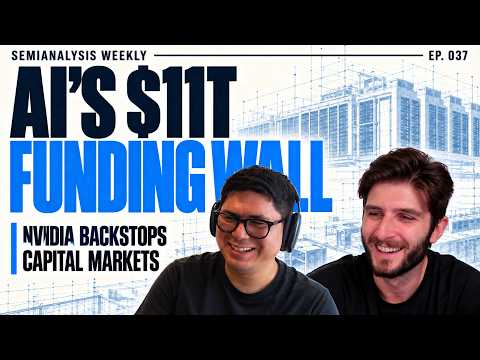
Ep. 037 - Who's Funding the $11 Trillion AI Buildout? (Capital Markets)
SemiAnalysis estimates $11.3 trillion in cumulative AI IT and data-center CapEx for 2024-29, implying roughly $7 trillion of debt by 2029 and $1 trillion of net funding this year.Hyperscaler and NVIDIA backstops, five-year offtakes, and frontier API gross margins near 90% could support financing, but lenders still face residual-value, churn, and execution risks.

Compute Is A Trillion-Dollar Market Trading In Group Chats | Brett Harrison & Andrawes Bahou
An approximately $1 trillion compute market still trades through calls, texts, Slack, and WhatsApp, while roughly 500 GPU-service providers and opaque brokerage chains create heterogeneous supply and “phantom power” without a standard forward curve.Architect is pursuing dated futures and options, with billing-system benchmarks, as CFTC reviews index reliability, but 20–25% financing costs expose unresolved credit risk.

'Big Short' Investor Explains How the AI Bubble Will Burst
AI’s immediate risk is concentration: Nvidia revenue rose roughly 110%, while 70% of accounts receivable came from five customers and OpenAI and Anthropic generated 70% of hyperscaler AI revenue.OpenAI’s roughly $6.5 billion quarterly revenue trails $12 billion in costs, highlighting a circular funding chain; with no durable LLM moat, Eisman favors picks-and-shovels while monitoring correction risk.

AI token demand
Shanghao JintmomohKevin SunKKKLousrexsongDZ书米亚光环RouletteJLZyellowcraneEl jefe
金尚浩认为,企业上线AI前必须持续标注私有数据、评估并post-train,市场以coding场景封顶token需求,系统性低估了算力消耗。其重构45万—50万行交易级代码时日耗约2000—3000美元token,并行调用70—100个agent,意味着GPU、CPU、带宽与连接需求都可能随企业数据闭环加速释放。
AI spending can't grow forever with P Equity Research | EP 167
Logan JastremskiP Equity Research
AI infrastructure is constrained less by GPUs alone than by a shifting stack of memory, advanced packaging, power, construction, and networking, with memory potentially absorbing roughly half of hyperscaler capex through 2028.Long-term agreements and higher utilization may support a higher earnings floor, but cannot repeal cyclicality if ROI and free cash flow disappoint.Watch ABF, optics, and China’s potential 20-25% global memory share.

The Ezra Klein Show: Jensen Huang Thinks A.I. Alarmism Has Gone Too Far
Ezra KleinJensen HuangKevin RooseCasey Newton
Jensen Huang calls AI safety a solvable engineering problem: labs should not ship systems they cannot contain, with liability rules and third-party audits still relevant.He argues NVIDIA compute could become a fungible, durable asset class, with one-gigawatt factories and annual rents reaching $50B.Open models have flipped to seventy-thirty, while supply-demand inversion and an uncertain digestion period remain risks.

ELITE Strategist: How to position for the NEXT AI trade
Warren Pies has flipped back to overweight equities, targeting an S&P 500 at 8,000 within the next few months as he sees a 1997-style Fed pause.Semiconductors remain the trade’s critical signal, with nearly 20% of market cap and a 90% performance spread between semi-up and semi-down days.GPU scarcity, rising B200 rental rates, and optimistic lab ARR support the AI bull case, while a renewed hiking cycle, venture-funding shock, or bipartisan data-center backlash could break it.
The Bottleneck Isn’t the Chip with Bubble boi | EP 166
AI’s scaling bottleneck is shifting from transistor shrinkage to packaging, interconnect, and memory, as tens or hundreds of billions of dollars may buy only 15–20% better density.NVIDIA’s roadmap increasingly depends on suppliers and technologies it does not control, while rack-scale architectures, flash offload, and smarter caching could determine whether the same hardware serves two or three times more users.